


As mental models go, there is one that is really special to me because it is so powerful and literally represents the native-digital world we live in. I call it network thinking, and I see it as a metaphorical “booster rocket” for design thinking.
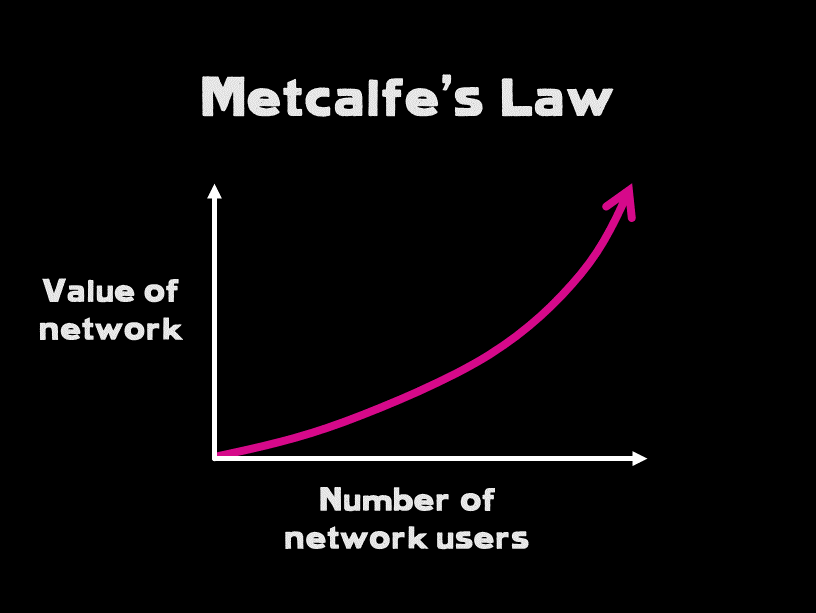
Network thinking is about understanding and applying the power-law dynamics of digital networks, most notably Metcalfe’s Law. Some people refer to this dynamic as the “network effect.”
Metcalfe’s Law states that the value of a network is proportional to the square of its number of users. In other words, a network’s value increases exponentially as more people join the network.
Now, Metcalfe’s Law is specific to telecommunications networks, and there is a lot more detail and nuance to unpack there. But the power-law dynamic is what’s most important for architects to understand and apply. And that dynamic, of course, is the potential for an exponential increase in value. As I like to think about it, this dynamic is a way of creating abundance.
This mental model is a potentially powerful (and disruptive) tool in the planning stages of a project. As you know, I design airports, and airports are typically planned by looking at current and future demand, and then right-sizing the capacity to meet that demand. That capacity comes in the form of resources (physical, human, and financial capital) such as new airport facilities.
In other words, the traditional design approach is that more demand = more resources. It is a 1:1 relationship.
However, I think it is a mistake to automatically assume that a projected increase in demand means a concomitant increase in resources. This is what I call the problem of linear thinking, which does not account for the potential for solutions with exponentially better outcomes. What Metcalfe’s Law and network thinking shows us is that we could potentially find exponential returns in capacity with a network solution.
I find that network thinking is not an intuitive way of thinking about design. Furthermore, its potentially disruptive nature as a solution means that this mental model should be applied with intention from the start.
For example, who would naturally come to the idea that Zoom is a better way to solve traffic congestion in our cities than building wider (or more) roads? But that’s exactly what we found out during the pandemic when everyone was forced to work from home, a situation enabled by telecommunications networks (Zoom, Teams, Webex, etc).
Network thinking starts by asking the question, “is there an existing network solution to my problem?” And it doesn’t necessarily need to be a telecommunications network. It’s more about asking the question, “has someone already built the rails to get us where we want to be?”
I saw this thinking play out when a group of interns at my firm were coming up with ideas to improve the passenger experience at an airport we regularly work with. To serve people with special needs better, they proposed that the airport authority join the “Wings for Autism / Wings for All” program, an already existing support network that has already figured out how to support special needs passengers so that airport staff can easily step in and help.
But if an existing network does not already exist, the next step is thinking about the feasibility of creating a new network solution. Although this requires more resources to create than an existing network solution, the potential is still all about creating outsized returns (i.e., value) relative to the resources put in.
This is what my firm did for our airport of the future concept (link). We proposed a new airside network of autonomous vehicles to take people from the terminal to their planes, which eliminates the need for traditional concourses and offers every passenger a VIP-like experience.
Creating a new network solution is also what the aviation industry is doing for the emerging Advanced Air Mobility (AAM) ecosystem. Aside from the new digitally-native network of air traffic management, AAM will find itself benefiting from leveraging the use of underutilized existing small- and medium-sized airports, which number in the thousands in the US.
Network thinking is also another way of thinking about digital transformation. It is not just the digitization of assets, it is the digital network that manages those assets that creates the value inherent in digital transformation.
Ultimately, I think what network thinking enables us as architects to do is to conceive brand new ways of how to live, work, move, and play — that is, creating new building types and urban typologies that offer unprecedented value as enabled by digital technologies, much like Uber as a network changed the way we move around cities and think about car ownership.
I would like us as architects to avoid the reflexive trap of linear thinking, and instead to consider alternative design solutions enabled by digital network technologies. I truly believe there is a way of creating something from nothing, or creating abundance where there was previously none.
Can cities and communities find, or create, a network solution for their housing problems?
For their homelessness problems?
For their mobility problems?
For their attracting investment and talent problems?
For their quality of life problems?
I honestly don’t know, but I have experienced network thinking as a great way of opening up new solutions and possibilities, and therefore I think it’s a great place to start.