


1. Summary
This report reveals that the conventional brick-and-mortar design brief is still built around a legacy belief: that the storefront is the primary container of local commercial value. That assumption is no longer stable. Digital discovery, app-based transactions, delivery platforms, flexible work, online trust systems, recommerce, remote services, creator economies, and adaptive reuse policy are unbundling the old storefront into separate functions: visibility, trust, transaction, service, fulfillment, production, gathering, and civic presence.
The strategic risk is not that every store disappears. The risk is that owners, cities, developers, and architects keep designing ordinary commercial shells as if the next viable use will simply be another conventional retailer. If this report’s thesis is true, the more dangerous design error is preserving the look of active retail while missing the operating logic of the post-retail building.
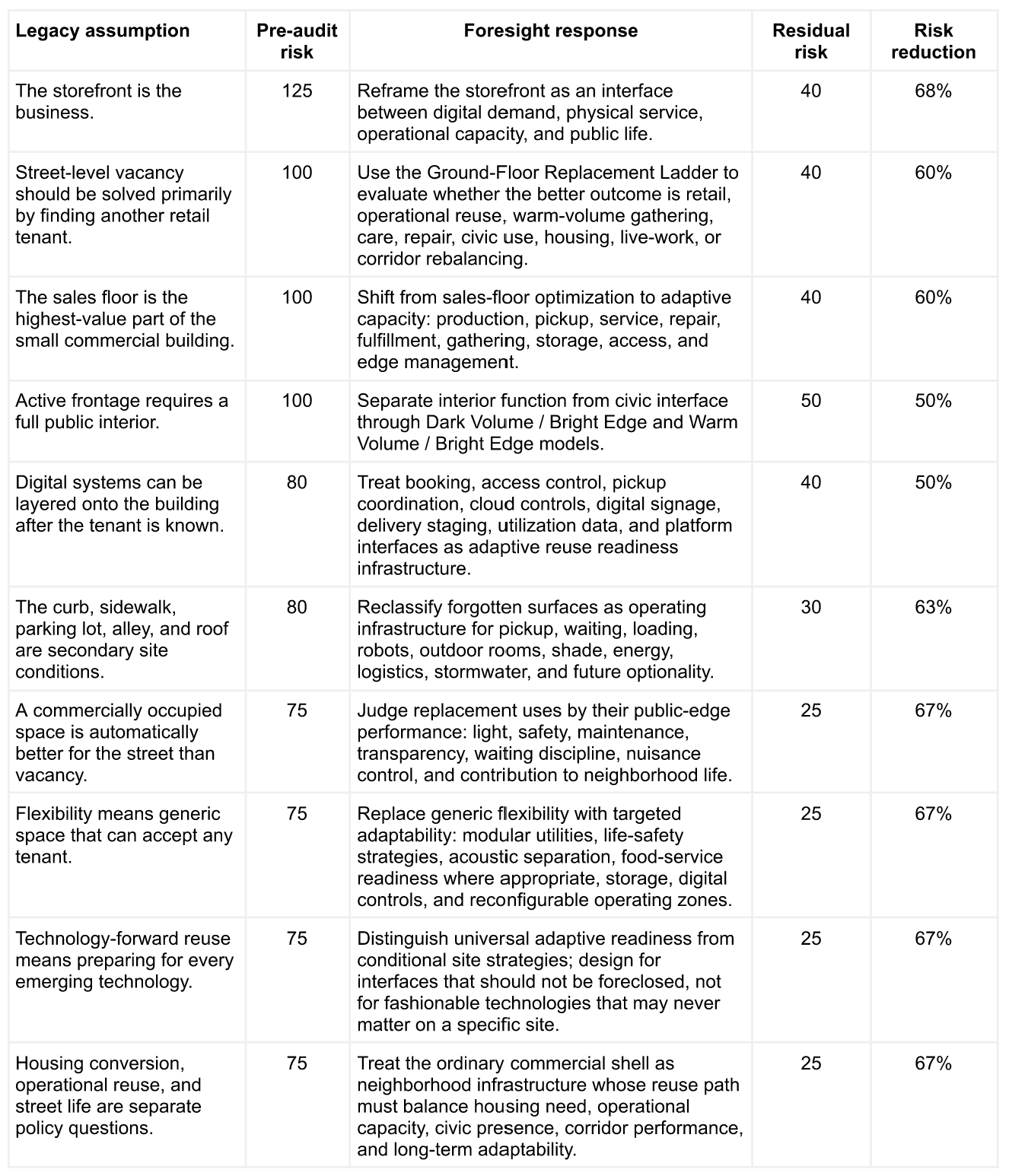
FFT identified 10 technology-sensitive assumptions and reduced modeled strategic assumption risk from 71/100 to 27/100, a 62% Strategic Assumption Risk Reduction.
2. The Basic Method
This audit asks: Which assumptions embedded in a conventional design brief become risky if this report’s thesis is true?
Strategic Risk Score = Consequence × Invalidation Pressure × Lock-In.
Each factor is scored 1–5. Maximum score per assumption is 125. Building foresight creates value by reducing lock-in. It turns fixed assumptions into more adaptive design, technology, operating, policy, or business-model criteria.
3. FFT Assumption Audit Table
4. Aggregate Result
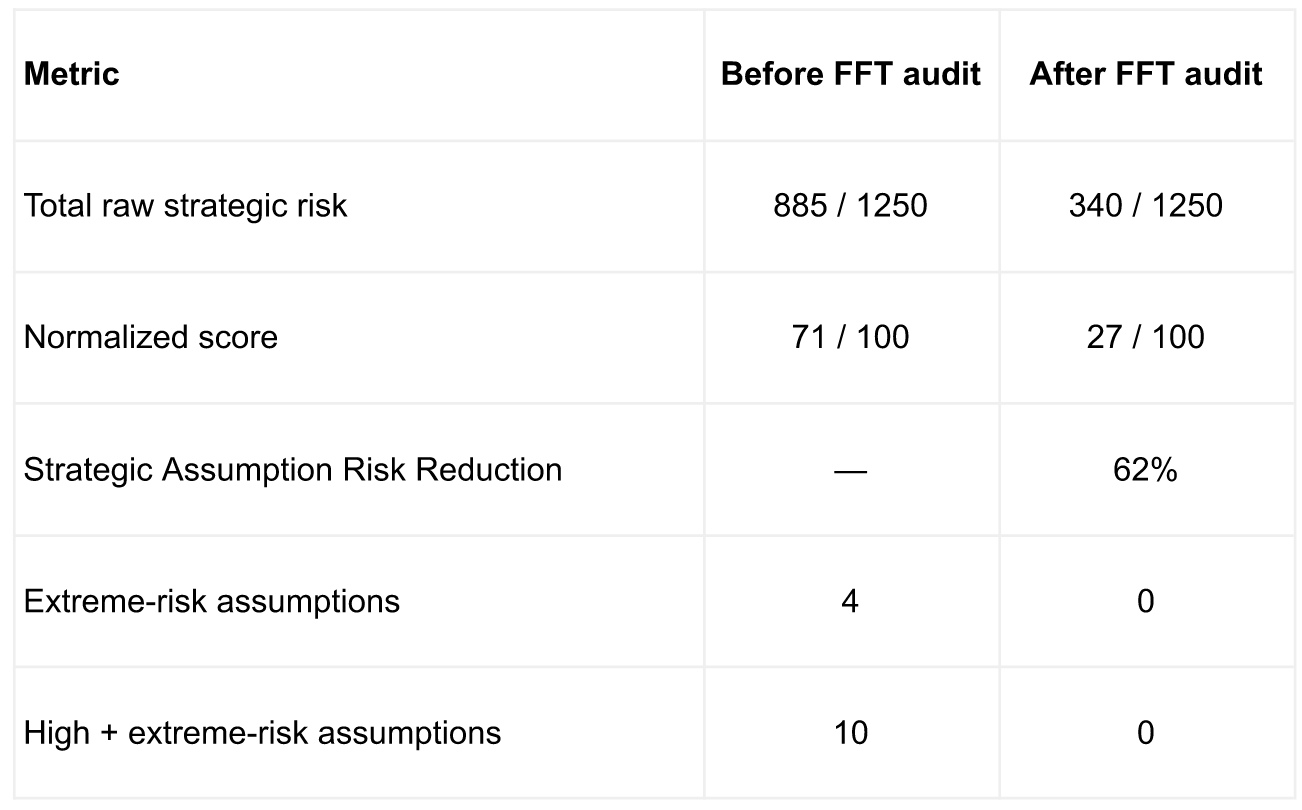
FFT identified 10 technology-sensitive assumptions and reduced modeled strategic assumption risk from 71/100 to 27/100, a 62% Strategic Assumption Risk Reduction.
5. Interpretation
The largest risk reduction comes from changing the basic question inside the design brief. The conventional question is: What tenant can fill this storefront? The report’s better question is: What should this building become capable of doing now?
That shift reduces risk because it prevents capital from being locked into a single outdated image of retail. A storefront may still support retail, but it may also need to support food production, recommerce, repair, pickup, care, tutoring, creator work, flexible meetings, short-term programming, civic use, housing, live-work, or some combination of these. The old brief assumes the shell becomes valuable when another tenant occupies it. The revised brief assumes the shell becomes valuable when it gains adaptive capacity.
The audit also shows that post-retail reuse creates a new civic obligation. Dark-volume uses may solve economic vacancy while weakening the street. Warm-volume uses may create beautiful rooms while failing financially. Housing conversions may add needed units while deadening the edge. Technology may improve coordination while pushing friction onto sidewalks and curbs. The report reduces strategic assumption risk by making these tradeoffs visible before owners, cities, architects, and operators commit to a narrow reuse path.
6. Credibility Caveat
This audit models strategic assumption risk. It does not prove long-term building performance, financial performance, user adoption, operational success, neighborhood acceptance, or public-realm improvement. The scores estimate the relative risk of designing around assumptions that may become invalid during the useful life of the asset. The value of the audit is not certainty; it is improved decision quality before capital, design, operating, technology, and governance choices become difficult to reverse.
