


1. Summary
This report reveals that the conventional stadium brief is still organized around a legacy belief: that the stadium contains the live sports experience. That assumption shaped capacity, parking, hospitality, broadcasting, revenue planning, district development, and the treatment of digital technology as an enhancement to the building rather than part of its underlying operating system.
The strategic risk is not that stadiums disappear. It is that owners, cities, developers, and architects continue investing in larger, more elaborate event containers while fandom becomes continuous, personalized, participatory, media-driven, and geographically distributed. The report reframes the stadium as the flagship node of a broader experience network connecting physical attendance, digital membership, content production, immersive viewing, neighborhood venues, creators, commerce, and community participation.
FFT identified 10 technology-sensitive assumptions and reduced modeled strategic assumption risk from 73/100 to 28/100, a 61% Strategic Assumption Risk Reduction.
2. The Basic Method
This audit asks: Which assumptions embedded in a conventional design brief become risky if this report’s thesis is true?
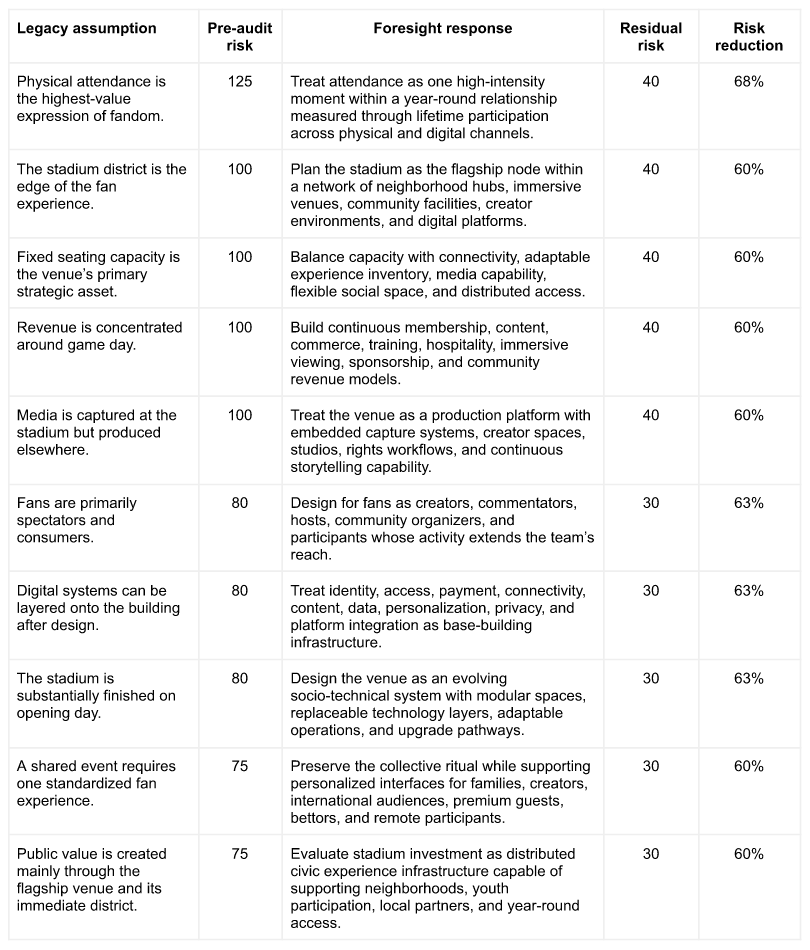
Strategic Risk Score = Consequence × Invalidation Pressure × Lock-In.
Each factor is scored 1–5. Maximum score per assumption is 125. Building foresight creates value by reducing lock-in. It converts fixed assumptions into more adaptive design, technology, operating, governance, and business-model criteria.
3. FFT Assumption Audit Table
4. Aggregate Result
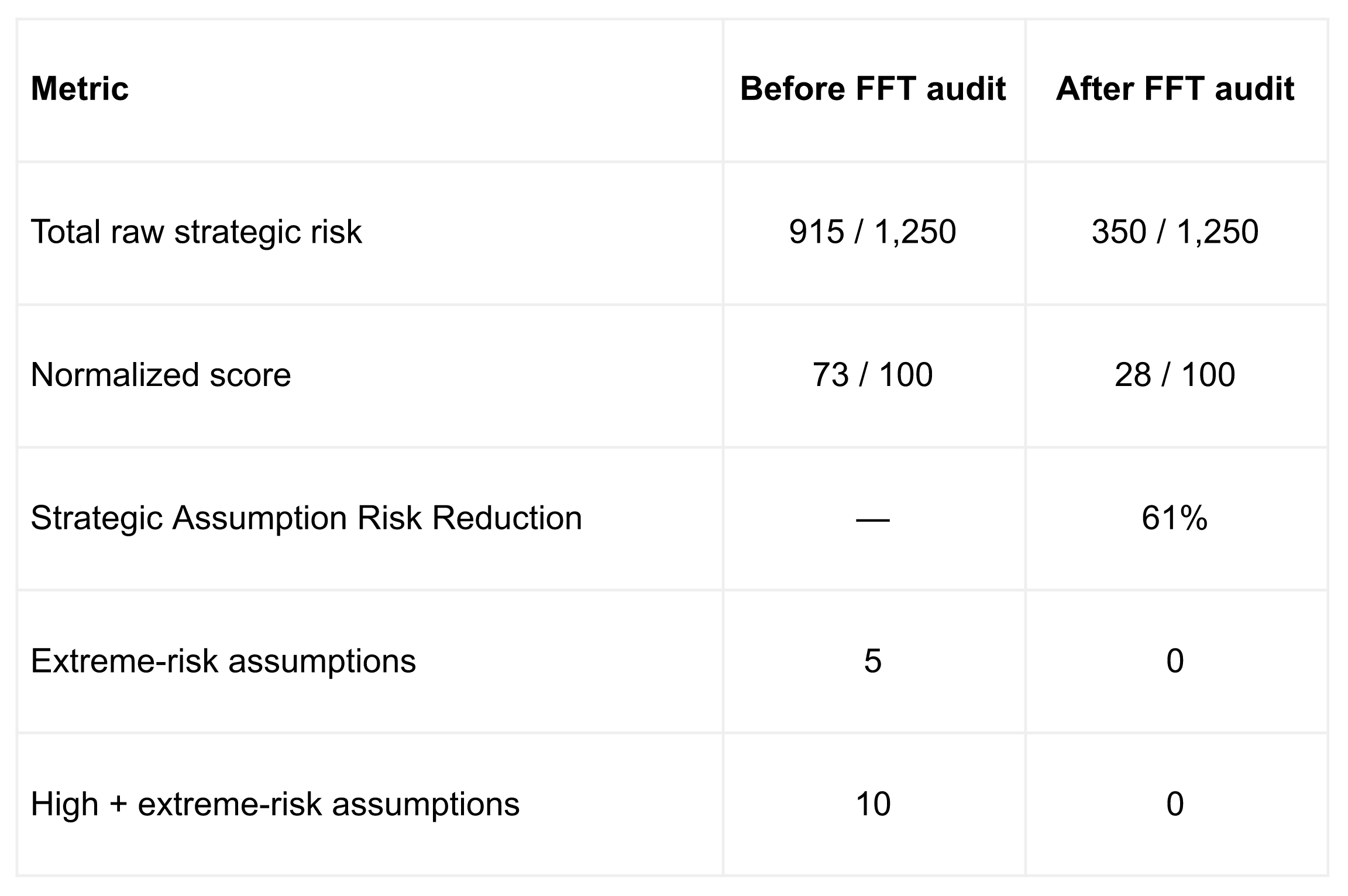
FFT identified 10 technology-sensitive assumptions and reduced modeled strategic assumption risk from 73/100 to 28/100, a 61% Strategic Assumption Risk Reduction.
5. Interpretation
The largest risk reduction comes from changing the basic question inside the stadium brief. The conventional question is: How many people can the venue accommodate and monetize on game day? The report’s better question is: What role should the stadium play within a continuous and distributed sports experience network?
That shift does not make seating, atmosphere, or iconic architecture less important. It prevents those assets from becoming the entire strategy. The revised brief treats the stadium’s long-term value as a function of connectivity: its ability to link attendance with membership, media production, creators, data, commerce, immersive experiences, neighborhood participation, and year-round programming. The report therefore reduces the risk of overbuilding fixed event capacity while underbuilding the digital, spatial, operational, and governance infrastructure required for the organization to function as an experience platform. The report itself identifies this transition from maximizing attendance to maximizing engagement as the central architectural consequence.
6. Credibility Caveat
This audit models strategic assumption risk. It does not prove long-term building performance, financial performance, fan adoption, operational success, civic benefit, or the commercial viability of distributed sports venues. The scores estimate the relative risk of designing around assumptions that may become invalid during the useful life of the asset. The value of the audit is not certainty; it is improved decision quality before capital, design, operating, technology, rights, and governance choices become difficult to reverse.