


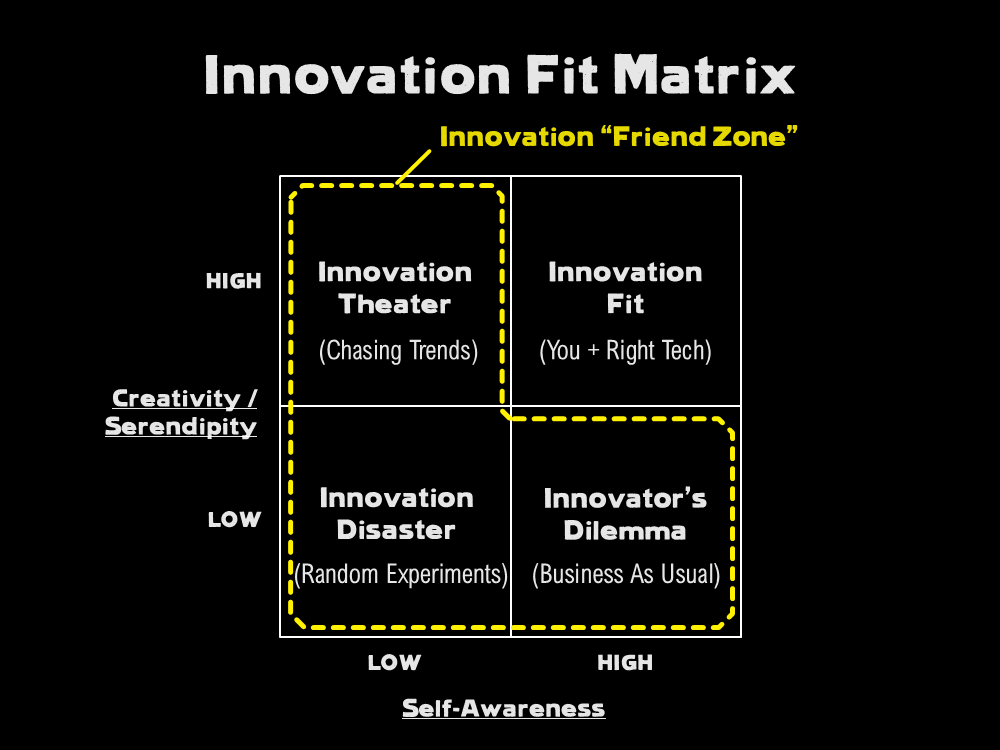
Innovation has to be one of the most desirable yet fleeting goals in business today. I mean, who doesn’t want to be innovative? It’s the banner under which companies launch new ideas, adopt flashy tech, and proclaim bold visions. And yet, for many, real innovation remains elusive — something admired from afar, but never quite within reach.
This is what I call the innovation friend zone — a place where you’re in love with innovation, but innovation doesn’t love you back. It’s a state of infatuation without actual transformation. You do all the right things on the surface, but nothing actually changes.
But of course I’m not talking about you specifically — I’m talking about companies, enterprises, organizations. Those stuck here usually chase trends without understanding what they truly need or can accomplish. They implement AI because others are doing it. They host design sprints with no real follow-through. They write innovation into their strategies, but never into their operations.
It’s performative. It’s safe. And it’s familiar.
But it’s not true innovation.💔
The friend zone is fundamentally about misalignment. Organizations are trying to be someone they’re not — either copying others or aspiring to ideals that don’t match their culture, strengths, or goals. In doing so, they ignore the deeper work required to foster meaningful, sustained innovation.
So how do you get out of the friend zone?
Like any good relationship, it starts with self-awareness. That means being brutally honest about your organization’s needs, strengths, and readiness. What problems are you really trying to solve? Where do you have real leverage or differentiation? What constraints are holding you back?
Most teams skip this step. They’re eager to act but unclear on direction. They fall in love with new technologies without understanding whether those tools fit their context. The result is innovation theater — lots of motion, very little progress.
Escaping the innovation friend zone requires a shift from ideas and inspiration to insight. Instead of looking outward first — what’s hot, what’s trending — organizations need to look inward. What outcomes matter most to our customers and clients? What capabilities do we already have that we’re not fully using? What patterns are we missing that could guide us?
Innovation is not about throwing ideas at a wall and seeing what sticks (even though that’s part of the process). It’s not about luck. It’s about fit. Only then do luck and serendipity become meaningful.
Innovation is about aligning three things: outcomes (what people need), capabilities (what you can do), and then ideas (what’s possible). When those things come together, innovation feels inevitable — not forced. It grows from your DNA, not in spite of it.
And that’s the key distinction. The goal is to become more yourself, more strategically focused, and more creatively aligned with your actual environment. Innovation, when done right, is less about being the first and more about being the most attuned.
It’s also not about doing everything differently overnight. Small, well-informed experiments can reveal massive opportunities when they’re grounded in real needs and strengths. But to get there, you need a framework for clarity and a system that surfaces possibilities you wouldn’t see otherwise.
Many organizations have had moments of breakthrough innovation — times when everything aligned and something remarkable happened. But those moments often feel like accidents. The challenge is turning that accidental innovation into a repeatable system.
That’s the opportunity ahead: to stop flirting with innovation and start building a relationship with it. A real one — measured, honest, and rooted in who you are.
Because the longer you stay in the friend zone, the more it hurts. You spend energy without progress. You watch others evolve while you feel left behind. And worst of all, you lose confidence in your ability to innovate.
But once you start asking better questions and tuning into your actual needs, things change. New ideas start to make sense. Trends become tools, not distractions. And innovation becomes not a gamble — but a path.
The friend zone may be common. But it’s not inevitable. Every organization has the potential to innovate — it just starts by understanding what innovation should mean for you.