


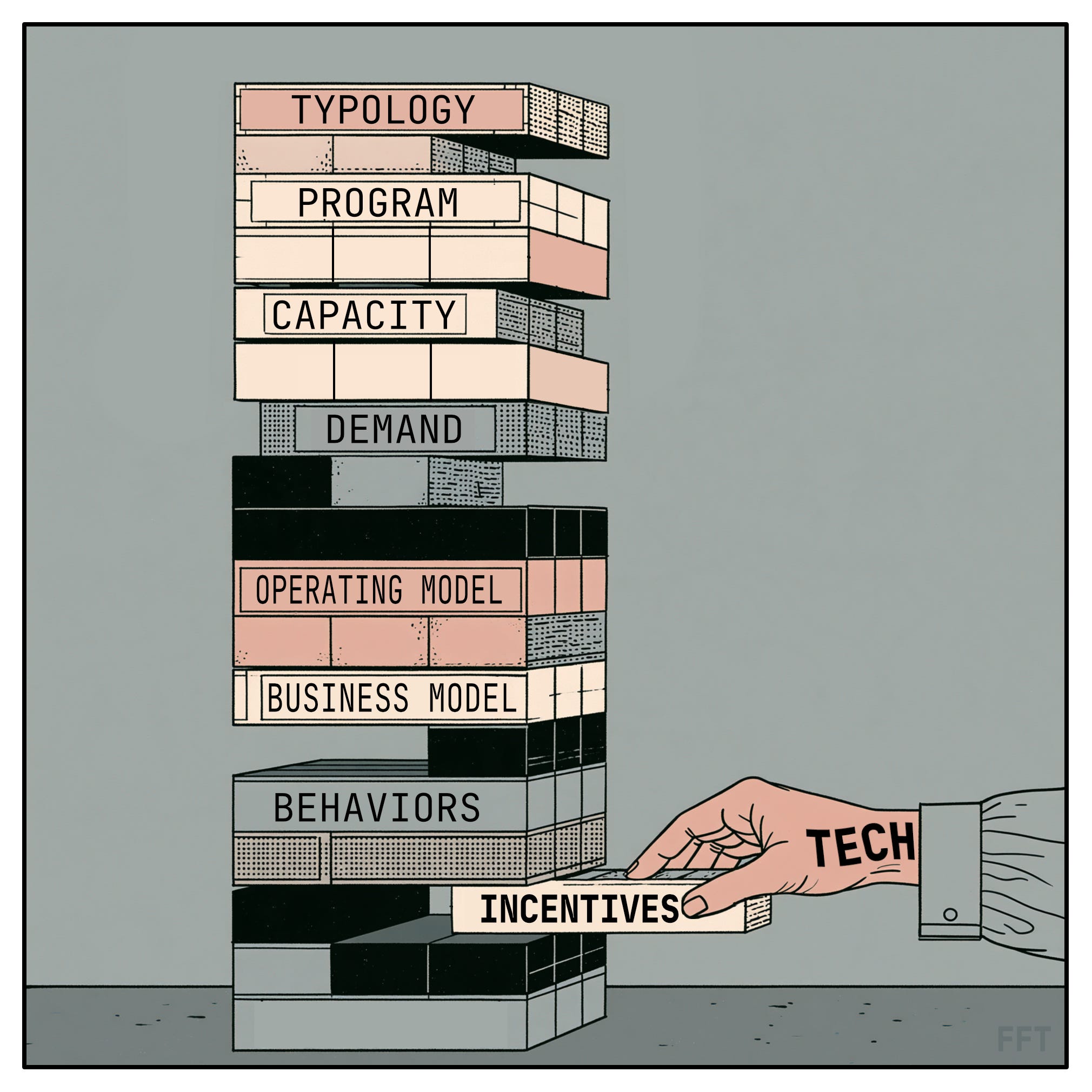
A building is one of the longest-lived decisions an organization will make. And yet, the assumptions behind that decision may last only a few years.
Technology changes how people work, move, shop, learn, travel, communicate, and consume services. It changes operating models. It changes business models. It changes what customers expect. It can change how much physical space is required, what that space needs to do, and whether some physical processes are necessary at all.
Yet major capital projects are still often planned in the opposite order. We forecast demand. We determine capacity. We establish a program. We design a building. Then we ask how technology fits inside it.
That sequence made sense when technology was largely equipment placed inside buildings. It makes less sense when technology can change the assumptions that determine the building in the first place.
Tech-First Capital Planning changes the order of operations. Before deciding what to build, ask what technology makes possible.
The Problem
Most capital projects begin with a physical question. How many square feet do we need? How many gates? How many classrooms? How many workstations? How many parking spaces? How many treatment rooms?
Those are important questions. But they are downstream questions. Each one is based on assumptions about how people will behave, how an organization will operate, how services will be delivered, and what resources will be needed.
A workplace needs a certain number of desks because of assumptions about when and where employees work.
An airport needs check-in counters because of assumptions about how passengers obtain boarding credentials and check baggage.
A university needs classrooms because of assumptions about how instruction is delivered.
A retailer needs sales floor because of assumptions about where customers discover, select, and purchase goods.
These are not architectural assumptions. They are operating assumptions expressed as architecture. And technology can change them. That is why capital planning increasingly needs to begin before the physical solution.
The Enemy: Design-Only Thinking
Design is essential. Design-only thinking is the problem.
Design-only thinking is the reflex to solve a physical problem with a physical design before asking how technology, operations, or changing behavior could alter the problem itself.
It starts with precedent:
We need a terminal, so we study terminals. We need an office, so we study offices. We need a school, so we study schools. We need a hospital, so we study hospitals.
The result may be excellent design. It may also be an excellent answer to yesterday’s question.
Tech-first thinking does not reject design. It moves design downstream of a more important inquiry:
What outcome are we trying to create, and what has become possible that was not possible before?
Three Risks
Tech-First Capital Planning is designed to address three recurring risks in long-lived physical assets.
1. Integration Risk
Modern buildings are not just buildings. They are combinations of physical space, digital systems, operations, people, data, equipment, networks, and interfaces.
Yet these components are often designed in professional silos. Architects design architecture. Engineers design systems. IT teams manage technology. Operators determine procedures. Vendors provide products. Contractors assemble everything.
Eventually, all of it has to work as one environment. That is where complexity becomes risk.
A building may be architecturally complete and operationally incomplete. A system may work individually and fail when connected to another. A technology decision made late may require redesign, rework, added infrastructure, or changes in operations.
The more complex the building, the more dangerous it is to think of technology as something that gets added later.
Tech-first thinking changes the object being designed. The object is not merely the building. The object is the functioning system the building enables.
The question:
What system are we trying to create, and what role should the building play within it?
2. Typology Risk
Buildings and technology operate on different clocks. Buildings can remain in service for decades. Technology, business models, operating practices, and human behavior can change in a fraction of that time. That creates a fundamental mismatch.
A physical asset can remain largely unchanged while the assumptions used to size, configure, and justify it become obsolete. This is typology risk:
The strategic risk created when long-lived physical assets are designed around assumptions about behavior, operations, and demand that may change much faster than the assets themselves.
The mistake is to treat this primarily as a forecasting problem. No planning team can reliably predict the future 20 or 30 years from now. The better question is:
Which assumptions should we commit to physically, and which should we keep flexible?
Future-proofing is not predicting the future. It is avoiding unnecessary commitments to one version of it. That is the value of optionality.
3. Possibility Cost
Not every risk is about something going wrong. Some of the largest losses are invisible. They are the better futures that were never considered.
Once a team begins with a familiar physical solution, the range of possible outcomes narrows quickly. If the problem is framed as, “How should we design this building?” then the answer will probably be a building. But the more important question may be:
What is the outcome, and what is now possible?
Technology may allow a process to disappear. It may allow demand to be distributed differently. It may reduce required capacity. It may increase the utilization of an existing asset. It may eliminate a transaction, a queue, a counter, a room, or an entire step in the user journey. It may create a new experience that precedent would never reveal. This is possibility cost:
The value forfeited when precedent determines the physical solution before alternative technology-enabled outcomes are considered.
The cost is difficult to see because nothing failed. The alternative was simply never imagined.
Change the Order of Operations
The conventional capital-planning sequence often looks something like this:
Demand → Program → Building → Technology
Tech-First Capital Planning changes the sequence:
Outcomes → Operations and Behavior → Technology → Assumptions → Physical Requirements → Integrated Solution
The difference is not that technology replaces design. It is that technology becomes part of strategic thinking before irreversible physical decisions are made. The result is three forms of value:
Integration
Make the whole system work.
Optionality
Preserve the ability to adapt.
Leverage
Create more outcome from physical capital.
Integration
Integration is the ability to treat the physical and digital environment as one operating system. It requires technology, architecture, engineering, operations, and user experience to be considered together early enough that meaningful choices remain available.
The goal is not technological sophistication. The goal is coherence. A simple system that works is more valuable than a sophisticated collection of systems that do not.
Tech-first planning therefore asks:
Which systems are critical to the desired outcomes?
Which systems depend on one another?
Which physical decisions depend on digital capabilities?
Which operating processes depend on both?
Where are responsibilities fragmented?
Which interfaces represent the greatest risk?
Integration makes complexity visible before complexity becomes expensive.
Optionality
Every physical decision closes some future possibilities. That is unavoidable. The objective is not unlimited flexibility. The objective is to avoid locking in assumptions unnecessarily.
Optionality may take the form of:
Adaptable space. Shared infrastructure. Open systems. Flexible capacity. Modular components. Software-defined processes. Multiple operating modes. Infrastructure that can support technologies not yet selected.
The question is not:
How do we predict the future?
It is:
What would we regret making difficult to change?
That question should be asked while change is still inexpensive.
Leverage
Traditional capital planning often assumes a linear relationship between demand and physical resources.
More passengers require more gates. More employees require more workstations. More students require more classrooms. More customers require more floor area.
Sometimes they do. But that relationship should be tested rather than assumed.
Technology can change utilization, coordination, access, scheduling, distribution, automation, and the movement of information. That creates leverage.
A familiar example is airline check-in. The desired outcome did not disappear. Passengers still need authorization to travel. But the process moved from a staffed counter, to a kiosk, to a device already in the passenger’s pocket. The physical infrastructure supporting the outcome changed.
The strategic question is therefore:
Can intelligence substitute for infrastructure?
Sometimes the answer will be no. Sometimes the answer will be partially. But when the physical alternative costs tens or hundreds of millions of dollars, even partial substitution can be consequential.
The goal is not simply efficiency. It is more outcome per unit of physical capital.
Five Questions Before Committing Capital
Before substantially committing a major project to a program or physical concept, leadership teams should ask five questions.
1. What outcome are we actually buying?
Separate the objective from the building traditionally associated with delivering it.
Are you buying offices? Or productive collaboration?
Classrooms? Or learning?
Gates? Or aircraft-processing capacity?
Parking spaces? Or access?
The way the problem is framed determines the range of possible answers.
2. What assumptions are we turning into infrastructure?
Every program contains assumptions. About staffing. Behavior. Transactions. Demand. Adjacencies. Queues. Mobility. Ownership. Operations. Utilization.
Make them visible.
An assumption becomes strategically important when it is about to become expensive to reverse.
3. Which assumptions could technology change?
Start with technologies and capabilities that already exist. Automation. Artificial intelligence. Digital identity. Mobile interfaces. Sensors. Networks. Robotics. Analytics. Scheduling systems. Remote operations.
Ask how those capabilities could change the process before asking how they should be installed in the building. Technology is not the answer. It is a variable.
4. What future options are we eliminating?
Every design decision creates path dependency. Some decisions are intentionally permanent. Others become permanent accidentally.
Ask:
What becomes difficult to change after we build this? Which assumptions are we comfortable betting on? Where is flexibility strategically valuable?
Optionality has value even when the future is unknowable. Especially when the future is unknowable.
5. Where could intelligence substitute for infrastructure?
Before adding capacity, test the problem.
Could better information reduce uncertainty? Could scheduling improve utilization? Could automation remove a process? Could a network distribute demand? Could digital access replace a physical transaction? Could existing assets work harder before new assets are built?
Physical infrastructure should remain an answer. It should stop being the automatic answer.
What Tech-First Thinking Is Not
Tech-first thinking is not about gadgets. It is not about smart buildings. It is not about choosing technology before understanding the problem. It is not about predicting the future. It is not about replacing architecture with software. And it is not about making every project experimental.
Tech-first thinking is a way of making better capital decisions under conditions of technological change. It starts with outcomes. It examines what technology makes possible. It challenges the assumptions behind the physical program. And only then does it ask what should be built.
Start From Possibility, Not Precedent
Precedent is useful. It tells us what has worked before. But precedent also contains yesterday’s assumptions. Technology changes the boundaries of what is possible.
So before repeating a familiar building type, process, room, capacity standard, or operating model, ask whether the assumptions behind it are still true. That is the fundamental discipline of Tech-First Capital Planning.
Start from possibility, not precedent. Before deciding what to build, ask what technology makes possible.
The New Capital Planning Question
The most consequential technology decision an organization makes may not be the technology it buys. It may be the building it constructs before understanding what technology will make possible.
A building is one of the longest-lived decisions an organization will make. Technology may change the assumptions behind that decision before the building even opens. So change the order of operations.
Define the outcome. Understand the system. Challenge the assumptions. Explore what technology makes possible. Preserve valuable options. Then decide what to build.
That is Tech-First Capital Planning. And it begins with one question: