


Editor’s Note
This is the first edition of a new monthly Form Follows Tech report series on how emerging technologies reshape building typologies, cities, infrastructure, and the built environment.
It is intentionally a long read — more than 10,000 words — because the goal is not to skim trends, but to develop a serious argument. We begin with stadiums, in the context of the World Cup.
If this report feels valuable, please click the heart. That signal will help me understand whether this kind of deeper strategic work is worth continuing.
To download the PDF version, click here:

Table of Contents
Executive Summary
Thesis
The live sports experience is decoupling from the stadium.
For more than a century, stadiums served as the singular destination for sports fans. They were designed around one fundamental assumption: the best—and often only—way to experience a game was to be physically present.
That assumption is rapidly changing.
Advances in streaming, artificial intelligence, mobile computing, creator economies, mixed reality, and immersive media have expanded the sports experience far beyond the stadium itself. Fans now interact with teams continuously through digital platforms, neighborhood communities, immersive venues, creators, and personalized content.
The stadium is no longer the entire experience.
It is becoming one interface within a much larger ecosystem.
What’s Changing
Sports organizations are evolving from venue operators into platform businesses.
Success increasingly depends on maximizing fan engagement rather than maximizing attendance.
Communities now exist across physical and digital environments simultaneously.
Content has become as strategically important as competition.
Membership increasingly replaces transaction.
Neighborhood experiences complement flagship venues.
Architecture shifts from accommodating spectators to enabling participation.
Why Now
Several technological and behavioral shifts are converging simultaneously:
Artificial intelligence enables personalized experiences at massive scale.
Streaming has eliminated geographic barriers to fandom.
Creator economies have decentralized sports media.
Mixed reality introduces entirely new forms of shared attendance.
Digital communities increasingly define fan identity.
Sports organizations seek year-round revenue rather than seasonal activity.
Together these forces are weakening the historical relationship between the stadium and the sports experience.
Biggest Implications
The stadium does not disappear.
Its role changes.
Future venues become flagship destinations within distributed networks of neighborhood hubs, immersive theaters, creator ecosystems, community facilities, and digital platforms.
Attendance remains important.
But engagement becomes the defining measure of success.
Architecture increasingly supports flexibility, media production, personalization, and year-round activation rather than simply maximizing seating capacity.
The team becomes the platform.
The stadium becomes its flagship interface.
Biggest Opportunities
Sports organizations can cultivate continuous relationships with supporters rather than episodic transactions.
Architects can design adaptable venues capable of supporting multiple forms of participation.
Developers can create distributed sports ecosystems rather than isolated entertainment districts.
Cities can extend economic benefits into neighborhoods through smaller connected venues.
Technology companies can build entirely new categories of immersive and personalized sports experiences.
The organizations that embrace distributed engagement earliest will likely define the next generation of live sports.
Biggest Risks
Organizations that continue measuring success primarily through attendance may underinvest in the broader fan ecosystem.
Overbuilding seating capacity while underinvesting in digital infrastructure may reduce long-term flexibility.
Cities that rely exclusively on mega-projects may miss opportunities for more resilient neighborhood-scale development.
Most importantly, teams that think of themselves only as sports franchises rather than experience platforms risk losing relevance as fan expectations continue to evolve.
Back to TOC
1. Core Thesis
The Live Sports Experience Is Decoupling from the Stadium
For more than a century, the stadium has been synonymous with live sports. It has served as the physical center of competition, community, media, and commerce. Teams built larger venues to accommodate more fans. Cities invested billions in landmark arenas. Architects optimized every aspect of stadium design around one central assumption:
If you wanted the best sports experience, you had to be there.
That assumption is beginning to break.
The defining trend shaping the next generation of sports venues is not simply better technology or more immersive entertainment. It is the gradual separation of the sports experience from the physical stadium itself.
This report argues that the live sports experience is decoupling from the stadium.
Watching a game is becoming only one component of a much larger ecosystem of physical and digital experiences. Fans increasingly interact with teams throughout the week rather than only during games. They consume content through creators, podcasts, fantasy sports, sports betting, social media, documentaries, virtual communities, and immersive venues. Every technological innovation extends the team’s presence beyond its home venue.
The result is a fundamental shift in what sports organizations actually sell.
Historically, they sold access to a game.
Increasingly, they sell membership in a year-round experience.
This transition mirrors broader technological shifts occurring across the economy. Software has repeatedly separated experiences from the places where they originally occurred. Banking became mobile. Retail became digital. Education became hybrid. Healthcare expanded beyond hospitals through telemedicine and remote monitoring.
Sports is entering a similar transition.
The stadium is no longer the exclusive place where fans engage with their teams. Instead, it is becoming one node within a distributed network of physical venues, digital platforms, creator ecosystems, immersive environments, and community experiences.
This does not mean stadiums disappear.
In fact, flagship venues may become more valuable than ever.
But their role changes.
Instead of acting as the sole destination, they become the flagship experience within a broader platform that reaches fans wherever they are.
For architects, developers, investors, and city leaders, this raises an important question:
If the sports experience no longer depends on a single stadium, what should tomorrow’s stadium become?
The answer is unlikely to be “larger.”
Instead, stadiums are evolving from places that maximize attendance into platforms that maximize engagement.
That distinction has profound implications for architecture, operations, economics, and urban development.
Back to TOC
2. Why Now
The live sports experience has been extending beyond the stadium for decades, but the current moment is different. Television expanded the audience. Streaming globalized it. Mobile computing made fandom continuous. Social platforms turned fans into publishers. AI now makes personalization scalable. Mixed reality and immersive venues are beginning to make remote attendance feel spatial, social, and premium.
The result is not one technology replacing the stadium. It is a convergence of technologies that finally makes the stadium’s old monopoly on live experience less absolute.
Several signals suggest the shift is already underway.
First, leagues are beginning to treat immersive venues as legitimate extensions of live attendance rather than novelty entertainment. The NBA and Cosm announced a long-term partnership to produce and distribute live NBA games in shared-reality venues through 2030 and beyond, with Cosm presenting games in large LED dome environments that create arena-like viewing experiences away from the actual arena. (Source)
Second, capital is moving toward shared-reality entertainment as a real venue category. Sony Pictures made a $100 million strategic investment in Cosm in June 2026, with Cosm operating venues in Los Angeles, Dallas, and Atlanta and planning additional locations in Detroit and Cleveland (Source).
Third, stadium districts are starting to absorb media infrastructure directly. Hollywood Park, anchored by SoFi Stadium, announced Hollywood Park Studios as part of a 300-acre media, entertainment, and technology destination, with the first phase including sound stages, production offices, broadcast support, and future AI-capable infrastructure (Source).
Fourth, the friction of attendance is being redesigned through identity and access systems. MLB’s Go-Ahead Entry allows enrolled fans to enter participating ballparks through facial authentication lanes without stopping to present a ticket, showing how the stadium gate is becoming a digital interface rather than a manual checkpoint (Source).
These signals point in the same direction. The stadium is not being replaced. It is being surrounded by new layers of participation, production, personalization, and distributed access. That is why the next generation of stadium strategy cannot be limited to better scoreboards, better concessions, or more premium seats. The larger question is how the stadium connects to the rest of the fan ecosystem.
Back to TOC
3. How Stadiums Were Originally Optimized
Modern stadiums are remarkable engineering achievements, but they are also products of a specific technological era.
Nearly every design decision embedded within today’s venues reflects constraints that existed long before smartphones, streaming media, artificial intelligence, or spatial computing.
Understanding where stadiums came from helps explain why they are now beginning to change.
Stadiums Solved a Problem of Scarcity
For most of sports history, access to the game was scarce.
There was only one field.
One game.
One time.
One location.
The only way to experience the atmosphere, emotion, and unpredictability of competition was to travel to the venue.
Architecture responded accordingly.
Stadiums became machines optimized for concentrating tens of thousands of people into one place for a few hours before sending them home as efficiently as possible.
Everything about their design reflected this objective.
Capacity determined success.
Parking enabled access.
Concessions generated additional revenue.
Luxury suites attracted corporate clients.
Scoreboards enhanced visibility.
Television infrastructure expanded audiences beyond the venue without fundamentally changing its role.
The underlying assumption remained constant:
The stadium was the experience.
The Economics of Attendance
The business model reinforced these architectural priorities.
Sports organizations generated revenue through a relatively small number of physical transactions:
Ticket sales
Parking
Food and beverage
Merchandise
Premium hospitality
Sponsorships
Broadcast rights
Nearly every revenue stream depended, either directly or indirectly, on the stadium serving as the central gathering place.
Success was measured by attendance.
A sold-out venue signaled competitive success, financial health, and civic relevance.
As a result, larger stadiums generally represented greater opportunity.
More seats meant more ticket revenue.
More visitors justified larger parking lots.
More foot traffic supported retail districts.
Cities competed aggressively to attract professional franchises because stadiums functioned as powerful economic anchors.
For decades, this model worked extraordinarily well.
The Assumptions Embedded in Stadium Design
Every building typology is based upon assumptions about technology, behavior, and economics.
Traditional stadiums assumed:
Fans travel to games.
Games happen in one location.
Physical attendance is the highest-value experience.
Broadcast is primarily passive.
Fans consume rather than create content.
Revenue is concentrated around game day.
Stadium utilization peaks only a few dozen times each year.
Many of these assumptions are becoming less reliable.
Not because sports are becoming less popular.
But because technology has fundamentally expanded how fans participate.
The challenge facing sports organizations today is not declining interest.
It is that fan engagement increasingly happens everywhere except the stadium.
Architecture has not yet caught up.
Back to TOC
4. Technology Forces Driving Decoupling
The transformation of live sports is often described as a story about artificial intelligence or virtual reality.
It is neither.
Instead, it is the cumulative effect of dozens of technologies that are steadily removing the historical advantages of physical attendance while simultaneously creating entirely new forms of engagement.
No single technology is replacing the stadium.
Together, however, they are redefining its role.
Streaming Eliminated Geographic Constraints
Television first expanded access to sports.
Streaming completed the transition.
Fans no longer need to live near their favorite team. They can follow clubs from anywhere in the world, consuming live games, documentaries, interviews, analysis, and behind-the-scenes content from multiple devices.
Teams increasingly cultivate global communities rather than regional fan bases.
For many supporters, the relationship with the club exists almost entirely outside the stadium.
Mobile Computing Turned Every Fan Into a Connected Participant
During games, fans no longer passively watch.
They simultaneously interact with statistics, betting platforms, fantasy leagues, social media, messaging apps, and second-screen experiences.
The smartphone has become another seat in the stadium.
In many cases, it commands as much attention as the field itself.
The sports experience now exists across multiple synchronized interfaces rather than a single physical viewpoint.
Creator Economies Expanded Sports Beyond the Broadcast
One of the least appreciated shifts in sports is the rise of independent creators.
Podcasters, YouTubers, livestreamers, analysts, former athletes, and fan communities now produce enormous amounts of sports content before, during, and after every game.
For younger audiences, following a favorite creator can be just as important as watching the official broadcast.
Sports organizations increasingly compete not only with other teams but with thousands of parallel media experiences.
The game has become an ongoing conversation rather than a scheduled event.
Artificial Intelligence Personalizes Every Experience
For decades, every spectator experienced essentially the same event.
AI changes that.
Future broadcasts may automatically generate personalized commentary, customized camera angles, language translation, statistics, betting information, fantasy updates, and instant highlight reels tailored to each viewer.
The traditional “one-size-fits-all” broadcast begins to fragment into millions of unique experiences.
Ironically, the digital experience may become more personalized than the physical one.
Mixed Reality Creates New Venues
Perhaps the most significant long-term shift is that sports no longer require a stadium to feel immersive.
Large-scale immersive theaters, extended reality headsets, volumetric capture, holographic displays, and spatial computing create entirely new ways to experience competition.
Instead of asking fans to travel to one venue, sports organizations can increasingly distribute high-quality shared experiences across many locations.
Neighborhood venues may eventually provide atmospheres rivaling today’s premium seating while remaining far closer to where fans actually live.
The sports experience becomes geographically distributed rather than geographically centralized.
Technology Changes Incentives
These technologies do more than improve convenience.
They change incentives.
Historically, organizations maximized attendance because attendance generated nearly every important revenue stream.
Increasingly, value comes from engagement rather than presence.
Subscriptions.
Digital memberships.
Content.
Data.
Personalized advertising.
Creator partnerships.
Betting.
Immersive experiences.
Remote participation.
The objective shifts from filling seats to maximizing lifetime fan engagement.
Once that happens, the stadium is no longer the product.
It becomes one interface within a much larger platform.
That shift, more than any individual technology, explains why the live sports experience is beginning to decouple from the stadium.
Back to TOC
5. Human Behavior Is Changing Faster Than Stadium Design
Technology rarely transforms buildings directly.
Instead, technology changes human behavior. Over time, buildings evolve to accommodate those new behaviors.
The same pattern is unfolding in sports.
While stadium architecture has changed incrementally over the past several decades, fan behavior has undergone a fundamental transformation. Today’s supporters consume sports differently, interact differently, socialize differently, and increasingly define fandom in ways that extend far beyond attending games.
Understanding these behavioral shifts is essential because they ultimately determine the future form of the stadium.
Fans No Longer Attend Sports—They Live Them
Historically, being a sports fan meant watching games.
Today, fandom is continuous.
Supporters follow transfer rumors, listen to daily podcasts, participate in fantasy leagues, place live bets, watch player documentaries, engage on Discord servers, consume creator content, purchase digital merchandise, and interact with athletes across social media.
For many fans, the game itself represents only a small percentage of their overall engagement.
Sports organizations increasingly compete for attention every day of the year rather than only on game day.
This changes the role of the physical venue.
Instead of serving as the primary touchpoint, the stadium becomes the most intense moment within an ongoing relationship.
Community Matters More Than Location
The internet has fundamentally altered what it means to belong to a sports community.
A supporter living thousands of miles from their favorite club may interact more frequently with fellow fans than someone living beside the stadium.
Digital communities increasingly organize around shared identity rather than geographic proximity.
This creates an important shift.
Sports organizations are no longer serving only local populations.
They are serving global communities.
Architecture must respond to this reality.
Rather than asking how to attract fans to one location, organizations increasingly need to design experiences that strengthen communities across many locations simultaneously.
The building becomes one expression of the brand rather than the entirety of it.
Fans Expect Personalization
The twentieth-century stadium delivered essentially the same experience to everyone.
Every spectator watched the same game.
Read the same scoreboard.
Heard the same announcer.
Purchased from the same concessions.
Technology has reshaped expectations.
Streaming services recommend personalized content.
Social media algorithms curate individualized feeds.
Music platforms generate custom playlists.
Retailers tailor recommendations to individual preferences.
Sports fans increasingly expect similar personalization.
Some want advanced statistics.
Others want betting integration.
Families prioritize convenience.
Corporate guests seek hospitality.
Creators need production infrastructure.
International audiences require multilingual experiences.
The future stadium will likely support many simultaneous experiences rather than one standardized event.
Architecture must become flexible enough to accommodate radically different modes of participation.
Convenience Is Becoming Non-Negotiable
Fans increasingly compare stadium experiences with everything else technology enables.
If groceries arrive in thirty minutes...
If ride-sharing removes parking headaches...
If streaming delivers every game instantly...
Why should attending a live event involve traffic, queues, expensive parking, and lengthy security lines?
Convenience is no longer merely an operational issue.
It has become a competitive advantage.
The physical experience must now justify the friction required to attend.
This places new pressure on venue operators to eliminate unnecessary delays while amplifying the unique aspects of in-person attendance that technology cannot replicate.
Participation Is Replacing Spectatorship
Perhaps the most significant behavioral shift is that fans increasingly expect to participate rather than simply observe.
They create content.
Share reactions.
Film celebrations.
Publish commentary.
Host live streams.
Build online communities.
The distinction between audience and media producer continues to blur.
The modern sports fan is simultaneously spectator, creator, commentator, and community builder.
Future venues will increasingly be designed to support content creation as an intentional feature rather than an unintended consequence.
Every seat has the potential to become a production studio.
Every visitor becomes part of the broadcast.
This represents a profound architectural shift.
The stadium is no longer designed only to showcase the athletes.
It increasingly supports millions of distributed storytellers.
Back to TOC
6. The Economics of Sports Ownership Are Shifting
Changes in technology and behavior ultimately reshape business models.
Sports organizations are no exception.
The traditional economics of professional sports revolved around maximizing attendance at a limited number of events each year. Revenue depended heavily on physical capacity, game-day spending, and media rights tied to scheduled broadcasts.
That model remains enormously valuable.
But it is no longer sufficient.
The modern sports franchise increasingly behaves less like a venue operator and more like a media, technology, and entertainment company.
Revenue Is Becoming Continuous
Historically, revenue arrived in predictable cycles.
Games generated ticket sales.
Fans bought concessions.
Sponsors purchased exposure.
Between events, stadiums sat largely dormant.
Digital platforms eliminate this rhythm.
Teams now generate value every day through streaming content, memberships, subscriptions, premium experiences, e-commerce, digital advertising, podcasts, creator partnerships, and year-round engagement.
Instead of monetizing attendance, organizations increasingly monetize attention.
This is a subtle but important distinction.
Attendance is episodic.
Attention is continuous.
The organizations that successfully extend fan engagement beyond game day dramatically expand their economic opportunities.
Media Is Becoming More Valuable Than Seating
Throughout much of the twentieth century, expanding stadium capacity represented one of the most direct paths toward increasing revenue.
Today, that relationship has weakened.
A single viral piece of content can reach more people than a sold-out stadium.
A global streaming audience may generate greater long-term value than local attendance.
Exclusive documentaries, player-driven media, behind-the-scenes access, creator collaborations, and personalized digital experiences increasingly become strategic assets rather than marketing tools.
Sports organizations are evolving into content platforms.
The stadium becomes both a venue for competition and a production facility for continuous storytelling.
Data Becomes a Strategic Asset
Modern sports organizations increasingly understand their fans through data.
Digital memberships.
Mobile applications.
Streaming platforms.
Retail transactions.
Loyalty programs.
Wearables.
Connected venue technologies.
Together, these systems create a far richer understanding of supporter behavior than ticket sales alone ever could.
The objective shifts from selling one seat to understanding one fan over an entire lifetime.
This changes investment priorities.
Technology infrastructure becomes as strategically important as physical infrastructure.
Membership Replaces Transaction
Traditional sports economics focused on individual purchases.
Buy a ticket.
Buy food.
Buy merchandise.
Leave.
Future organizations increasingly seek ongoing relationships.
Monthly memberships.
Premium digital communities.
Exclusive content.
Creator access.
Training experiences.
Neighborhood clubs.
Behind-the-scenes events.
The objective becomes increasing lifetime engagement rather than maximizing individual transactions.
This mirrors broader shifts occurring across media, software, and entertainment.
The most valuable customer is no longer the one who spends the most during a single game.
It is the one who remains deeply connected throughout the year.
Stadiums Become Flagship Assets
None of this diminishes the importance of iconic venues.
Quite the opposite.
As routine viewing becomes increasingly digital, the physical stadium becomes more valuable as a destination experience.
Its role, however, changes.
Rather than functioning primarily as a container for spectators, it becomes the flagship expression of a much larger brand ecosystem.
The stadium anchors identity.
The platform extends reach.
Back to TOC
7. Why Attendance Is No Longer the Primary KPI
For decades, attendance served as the defining measure of a successful sports organization.
Higher attendance meant stronger demand.
Stronger demand generated greater revenue.
Greater revenue justified larger venues.
The relationship appeared straightforward.
That equation is beginning to change.
Attendance remains important.
But it is no longer the single most meaningful indicator of organizational success.
Engagement Matters More Than Presence
A fan attending one game each season may generate less long-term value than someone who interacts with the team every day online.
Daily podcast listener.
Fantasy participant.
Digital subscriber.
Merchandise buyer.
Social media contributor.
Premium membership holder.
Content creator.
These supporters may rarely enter the stadium.
Yet they contribute significantly to the organization’s economic ecosystem.
The key metric becomes engagement rather than occupancy.
The Network Is Larger Than the Venue
Traditional stadium thinking measures only the people inside the building.
Modern sports organizations increasingly measure the entire network.
How many people are watching remotely?
How many are participating through creator communities?
How many attend neighborhood viewing events?
How many interact with digital experiences before, during, and after the game?
The audience extends far beyond physical seating capacity.
The venue no longer defines the community.
The community defines the venue.
Success Becomes Multi-Dimensional
Instead of asking:
“How many people attended?”
Organizations increasingly ask:
How many fans engaged this week?
How many subscriptions were renewed?
How much content was shared?
How many creators amplified the event?
How much time did supporters spend interacting with the brand?
How many neighborhoods hosted official watch experiences?
How many digital members participated?
Attendance becomes one metric among many rather than the primary measure of success.
The Architectural Consequence
This change in measurement ultimately changes architecture.
When attendance dominates decision-making, designers maximize capacity.
When engagement becomes the objective, designers maximize experiences.
Some venues may indeed become smaller.
Others may maintain similar capacities while dramatically increasing the diversity of experiences offered within them.
Premium hospitality.
Interactive media studios.
Creator production spaces.
Flexible social terraces.
Mixed-reality environments.
Community gathering areas.
Youth participation facilities.
Training experiences.
The question is no longer:
“How many seats can we build?”
It becomes:
“How many meaningful ways can people participate?”
That represents a fundamental shift in stadium design philosophy.
The architecture of the future sports venue will not be defined by the number of spectators it contains.
It will be defined by the richness of the experiences it enables—both inside and far beyond its physical boundaries.
Back to TOC
8. Stadium Evolution: From Bowl to Platform
Every building typology reflects the dominant technologies and economic incentives of its time.
Factories evolved alongside mechanization.
Office towers emerged with elevators and centralized administration.
Shopping malls reflected the rise of suburban automobile culture.
Stadiums are no different.
Their evolution can be understood as a series of responses to changing technologies, business models, and fan behaviors. As those forces continue to evolve, so too will the architecture of live sports.
The next generation of stadiums will not simply be smarter versions of today’s venues.
They will represent an entirely different typology.
Stadium 1.0 — The Bowl
The original stadium was an engineering solution to one problem:
How do you allow as many people as possible to watch the same event simultaneously?
The answer was simple.
Build bigger.
The stadium bowl optimized sightlines, structural efficiency, crowd movement, and seating density.
Revenue came almost entirely from filling seats.
The architecture reflected this objective.
Everything else was secondary.
Stadium 2.0 — The Entertainment District
As sports organizations sought to generate revenue beyond game day, the stadium expanded into a mixed-use destination.
Hotels.
Restaurants.
Retail.
Museums.
Public plazas.
Concert venues.
Residential development.
Rather than functioning as isolated buildings, stadiums increasingly became anchors for entertainment districts.
The goal shifted from maximizing attendance during events to generating activity throughout the year.
Many cities continue to pursue this model today.
Yet even this represents only a partial evolution.
The district still revolves around the stadium.
The stadium remains the center of gravity.
Stadium 3.0 — The Media Platform
The next evolution changes the stadium’s primary purpose.
Rather than simply hosting spectators, it becomes a sophisticated media production environment.
Every game produces enormous amounts of digital content.
Multiple broadcast feeds.
Player interviews.
Creator collaborations.
Behind-the-scenes experiences.
Fan-generated media.
Interactive statistics.
Personalized highlights.
Social content.
The venue increasingly operates like a live production studio.
Every physical experience becomes a digital asset.
Architecture begins supporting content creation as intentionally as it once supported broadcasting.
Camera infrastructure becomes embedded throughout the venue.
Flexible production spaces replace underutilized back-of-house areas.
Hospitality environments double as podcast studios.
Premium experiences prioritize storytelling as much as viewing.
The stadium becomes both performance venue and content factory.
Stadium 4.0 — The Platform
As digital engagement expands, the organization itself begins operating as a platform rather than a venue.
The stadium remains the flagship experience.
But it is no longer the only interface.
Supporters interact through:
Streaming services
Mobile applications
Fantasy sports
Betting platforms
Creator communities
Social media
Retail
Memberships
Youth academies
Community events
Digital collectibles
Immersive media
The venue anchors this ecosystem without containing it.
Architecturally, this changes priorities.
Success depends less upon maximizing capacity and more upon strengthening connections between physical and digital experiences.
The stadium becomes a platform for participation.
Stadium 5.0 — The Distributed Network
The final evolution is the most transformative.
Instead of asking fans to travel toward one destination, organizations increasingly bring the experience closer to where fans already live.
Neighborhood viewing venues.
Immersive theaters.
Mixed-reality sports bars.
Community clubhouses.
Training facilities.
Youth academies.
University partnerships.
Pop-up fan experiences.
Digital twins.
Virtual attendance.
The sports experience becomes geographically distributed.
Rather than replacing the flagship stadium, these new nodes expand its reach.
The result resembles an airline hub-and-spoke network.
The flagship venue remains essential.
But it operates alongside dozens—or eventually hundreds—of connected locations.
The team becomes the platform.
The stadium becomes its flagship node.
That distinction fundamentally changes how future sports architecture will be conceived.
Back to TOC
9. Emerging Stadium Typologies
When technologies change incentives, entirely new building types emerge.
The next generation of sports architecture will not consist of one universal stadium model.
Instead, organizations will develop specialized venues designed for different forms of participation.
Below are several typologies likely to emerge over the next two decades.
The Neighborhood Stadium
Rather than building increasingly massive regional venues, organizations develop smaller community-focused facilities distributed throughout metropolitan areas.
These venues host:
Youth sports
Watch parties
Training sessions
Community programming
Local tournaments
Team events
Retail
Food and beverage
On game day they transform into official viewing destinations connected directly to the flagship stadium.
Instead of one gathering place for eighty thousand people, a city may support dozens of neighborhood sports hubs serving thousands of fans simultaneously.
The experience becomes more local while remaining globally connected.
The Creator Stadium
Content production becomes part of the architectural program.
Dedicated podcast studios.
Broadcast suites.
Creator lounges.
Influencer collaboration spaces.
Professional editing facilities.
Fan interview zones.
Interactive production stages.
Instead of discouraging recording, the venue actively encourages media creation.
Every visitor becomes a publisher.
The organization gains thousands of independent storytellers extending its reach.
Architecture becomes marketing infrastructure.
The Immersive Arena
Not every sports experience requires the game itself.
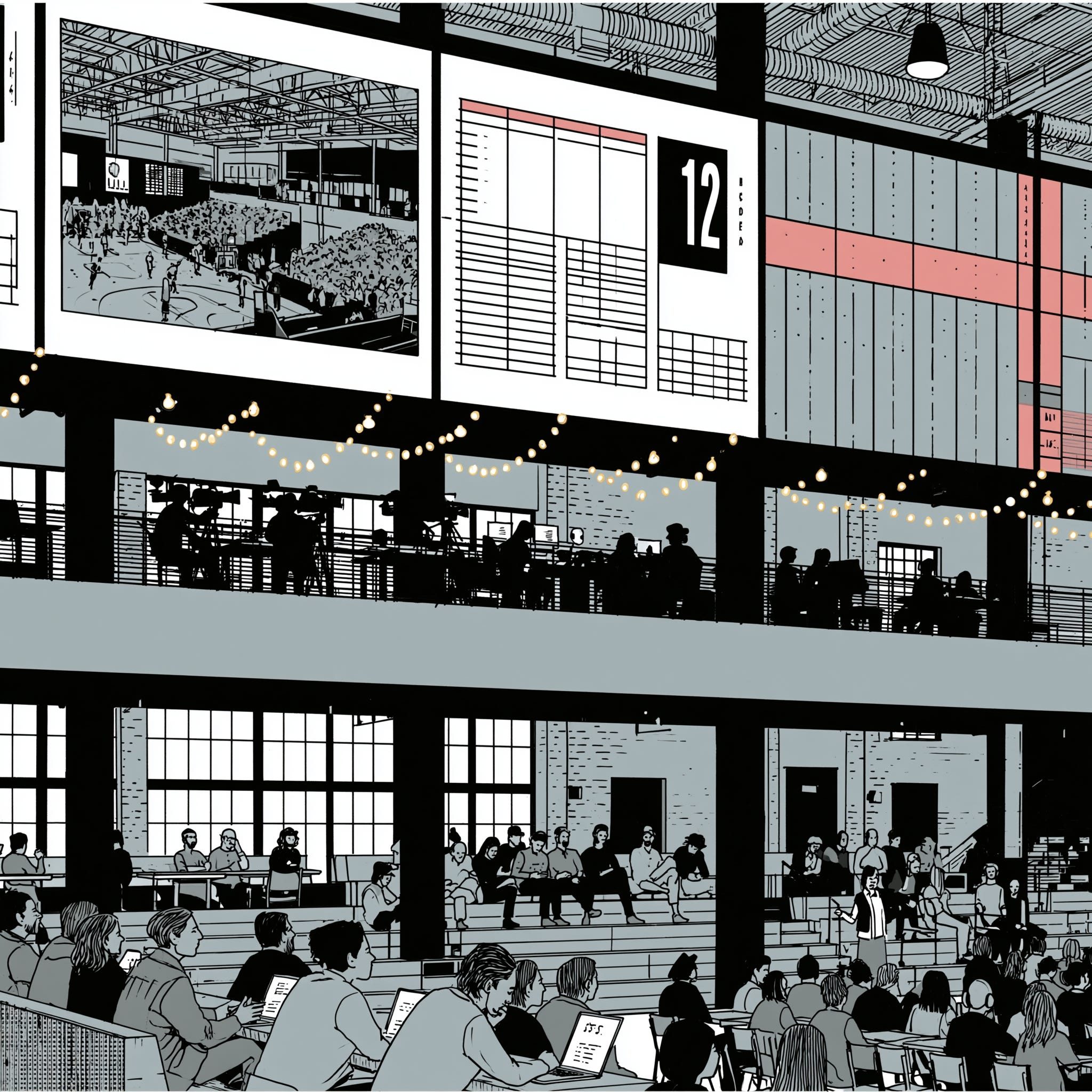
Large immersive theaters equipped with ultra-high-resolution displays, volumetric projection, spatial audio, and mixed reality allow supporters to experience events together without traveling to the flagship venue.
These spaces combine the atmosphere of live attendance with the convenience of local access.
For many fans, they may become preferred destinations.
The Adaptive Stadium
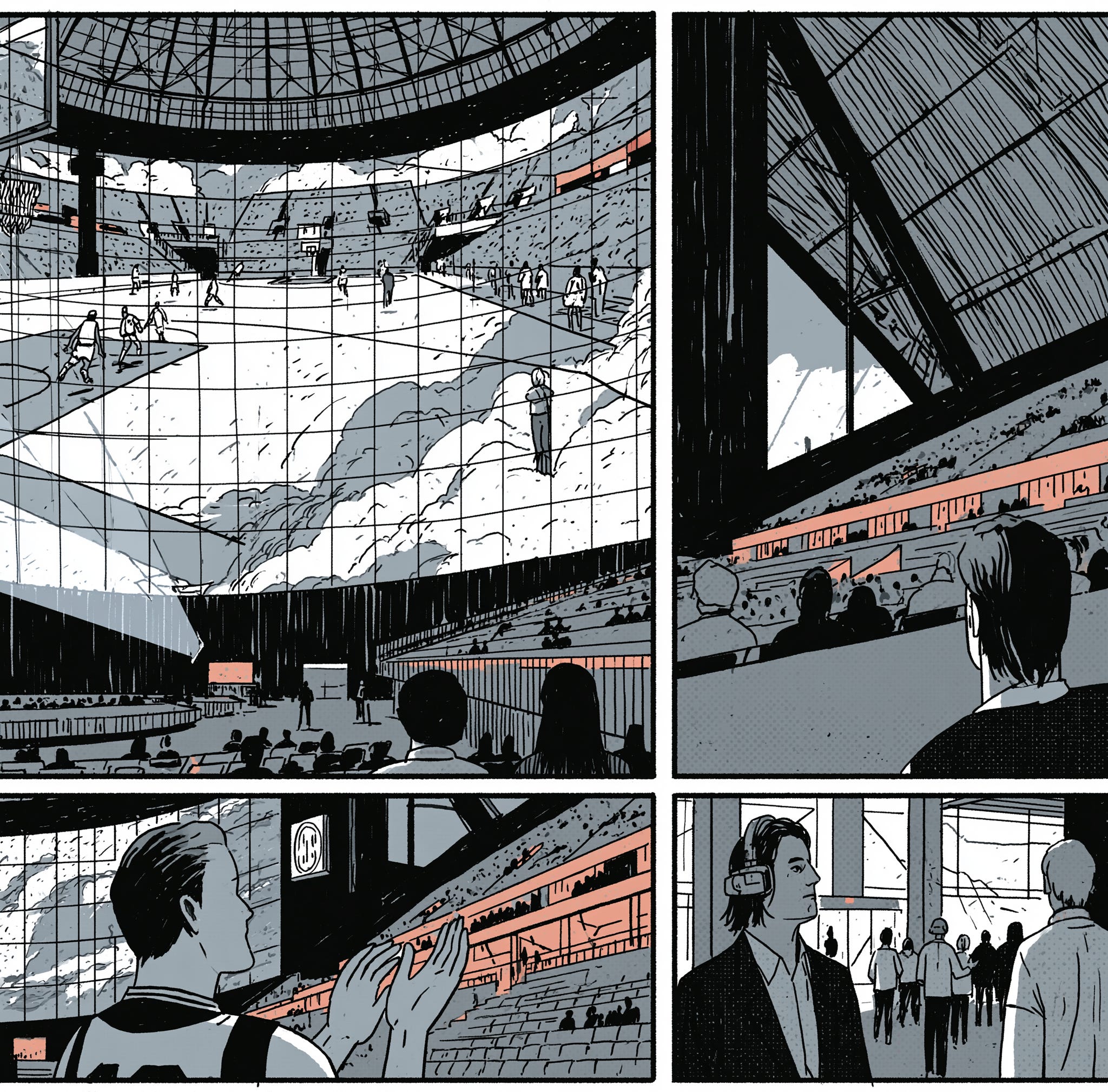
Future venues become physically dynamic rather than static.
Movable seating.
Modular hospitality.
Flexible event spaces.
Retractable production infrastructure.
Programmable environments.
Capacity adjusts according to demand.
Sections transform throughout the week.
Spaces optimized for football on Sunday may support esports, concerts, conventions, creator festivals, or community programming during the remaining days.
Architecture becomes operationally flexible rather than permanently fixed.
The AI Stadium
Artificial intelligence quietly orchestrates every aspect of the visitor experience.
Personalized navigation.
Dynamic seating upgrades.
Predictive concessions.
Crowd optimization.
Real-time translation.
Customized commentary.
Adaptive lighting.
Individualized wayfinding.
Every visitor experiences the venue differently.
Instead of one stadium serving fifty thousand people, the AI Stadium delivers fifty thousand personalized experiences simultaneously.
The building becomes responsive rather than static.
Back to TOC
10. Business Models Beyond Ticket Sales
Every typological transformation is ultimately driven by economics.
Buildings change because business models change.
The future stadium will be no exception.
Historically, nearly every financial decision revolved around maximizing attendance.
Tomorrow’s organizations will optimize for something much broader.
From Transactions to Relationships
The traditional model emphasized individual purchases.
A fan bought a ticket.
Purchased food.
Bought merchandise.
Went home.
The relationship largely ended until the next game.
Digital platforms make continuous engagement possible.
Membership replaces transaction.
Organizations increasingly cultivate year-round relationships through subscriptions, exclusive content, community access, and premium experiences.
The objective becomes maximizing lifetime fan value rather than maximizing game-day spending.
From Seating Inventory to Experience Inventory
For decades, the stadium’s primary asset was its seating capacity.
Future organizations increasingly monetize experiences rather than seats.
Examples include:
Premium behind-the-scenes access
Creator workshops
Youth training academies
Team-operated travel experiences
Immersive viewing events
AI-personalized hospitality
Exclusive practice sessions
Digital memberships
Interactive coaching experiences
Community festivals
Revenue diversifies beyond physical attendance.
The team’s brand becomes the product.
From Game Days to 365-Day Operations
Many stadiums currently operate at full capacity only a few dozen days each year.
This creates enormous inefficiencies.
Future venues increasingly become year-round destinations.
Sports medicine clinics.
Esports competitions.
Fitness facilities.
Education programs.
Corporate events.
Media production.
Entertainment festivals.
Innovation showcases.
Retail.
Restaurants.
Community programming.
The objective is no longer maximizing utilization during the season.
It is maximizing relevance every day of the year.
The Rise of Distributed Revenue
As the sports experience expands geographically, revenue becomes distributed as well.
Neighborhood venues.
Immersive theaters.
Digital memberships.
Remote attendance.
Virtual merchandise.
Creator partnerships.
Localized sponsorships.
Regional fan clubs.
Organizations become less dependent upon a single physical asset.
Instead of concentrating economic activity inside one stadium, they cultivate a network of complementary experiences generating value across entire metropolitan regions—and increasingly around the world.
Measuring Success Differently
The business questions of the future become fundamentally different.
Instead of asking:
“How do we sell more tickets?”
Organizations increasingly ask:
How do we deepen fan relationships?
How do we create more participation?
How do we empower creators?
How do we extend engagement beyond game day?
How do we activate neighborhoods rather than one venue?
How do we monetize community rather than attendance?
These questions produce different buildings.
Instead of maximizing capacity, architects maximize flexibility.
Instead of designing isolated venues, planners design interconnected ecosystems.
Instead of creating destinations visited a few times each year, developers create platforms that support continuous engagement.
This is the central architectural implication of the report.
The future of live sports is not defined by a bigger stadium.
It is defined by a larger ecosystem.
The stadium remains important—but no longer stands alone.
It becomes the flagship experience within a distributed network of physical places, digital platforms, immersive media, and communities that together redefine what it means to attend a game.
Back to TOC
11. Signals and Case Studies
Signal 1: Cosm and the Rise of Shared-Reality Sports Venues
Cosm is one of the clearest signals that live sports can become spatial without being stadium-bound. Its immersive venues use large wraparound LED domes to present live sports and entertainment in a shared physical environment. The strategic importance is not simply the screen quality. It is the business model: a live event occurring in one city can become a premium group experience in many other cities.
The NBA’s long-term partnership with Cosm matters because it legitimizes distributed attendance as part of the official sports experience rather than an unofficial watch party. Cosm’s expansion into multiple U.S. markets suggests that immersive sports may become a repeatable venue type: smaller than a stadium, more social than home streaming, and more spatial than a sports bar (Source).
Built-environment implication: The “remote venue” becomes a new sports typology. It does not replace the stadium. It extends the stadium’s atmosphere into other markets.
Signal 2: Hollywood Park as Stadium-District-Media Campus
Hollywood Park illustrates the next stage of the stadium district. It is not only a mixed-use development around a stadium. It is becoming a media, entertainment, and technology campus. The planned Hollywood Park Studios will support production, broadcast operations, and post-production activities, with its first major use as the International Broadcast Center for the 2028 Olympic and Paralympic Games (Source).
This matters because it shows how stadium-adjacent real estate is beginning to merge with content infrastructure. The stadium is no longer just an event anchor. It becomes part of a media supply chain.
Built-environment implication: Future stadium districts may compete less on retail adjacency and more on their ability to produce, distribute, and monetize media.
Signal 3: YouTube Theater and the Creator-Event Hybrid
YouTube Theater at Hollywood Park was designed as a 6,000-seat venue for concerts, esports, community gatherings, conferences, and creator events. Its partnership language explicitly connects physical events with livestreams, video-on-demand, creators, and global digital audiences (Source).
This is an important precedent because it positions a venue not only as a place for spectators but as a bridge between live gathering and creator-driven distribution.
Built-environment implication: Sports venues will increasingly need smaller, more flexible companion spaces that can support creators, live shows, esports, podcasts, fan events, and digital distribution.
Signal 4: MLB Go-Ahead Entry and the Stadium Gate as Interface
MLB’s Go-Ahead Entry shows how the most mundane parts of the stadium experience are becoming digitally redesigned. The gate is no longer just a security and ticketing threshold. It becomes an identity, access, data, and trust interface (Source).
The significance is not that every stadium will adopt the same system. The significance is that fans will increasingly compare live attendance with the ease of digital experiences. Long lines, confusing entry, payment friction, and static wayfinding will feel less acceptable as other parts of daily life become more seamless.
Built-environment implication: Arrival, entry, concessions, navigation, and exit should be treated as design problems that combine architecture, software, operations, staffing, and governance.
Back to TOC
12. Second-Order Effects
The decoupling of live sports from the stadium produces consequences beyond fan experience. It changes capital allocation, public-private development logic, sponsorship, privacy, venue programming, and the professional boundaries between architecture, media, operations, and technology.
1. Stadium Value Shifts from Capacity to Connectivity
The most valuable stadiums will not simply be the largest. They will be the most connected. A venue’s long-term value will depend on how well it connects physical attendance to membership, content, commerce, data, creators, sponsors, neighborhood nodes, and immersive experiences. Capacity still matters, but connectivity increasingly determines how much value the organization can capture beyond the event.
2. The Seating Bowl Becomes Less Dominant in the Design Brief
The seating bowl will remain emotionally and architecturally central, but it will no longer define the entire venue strategy. More value will migrate to flexible edge spaces: terraces, clubs, concourses, studios, plazas, hospitality rooms, training areas, community facilities, and media infrastructure. These spaces will determine whether the stadium can operate as a year-round platform rather than a seasonal container.
3. Stadium Subsidy Debates Become More Complicated
Cities have traditionally justified stadium investment through tourism, jobs, civic identity, tax revenue, and district development. A distributed sports model changes the public-value question. If the team’s economic and social footprint can extend across neighborhoods, cities should ask for more than a landmark venue. They should ask for connected community infrastructure, youth access, local programming, transit coordination, and measurable year-round benefits.
4. Media Rights Become Spatial Rights
As immersive viewing, distributed venues, and personalized content become more important, media rights will increasingly determine what kinds of spaces can exist. A neighborhood immersive venue is not only a real estate concept. It is a rights-management problem. The ability to show live games, alternate feeds, player views, behind-the-scenes content, or AI-personalized broadcasts will shape the business model of future sports spaces.
5. Privacy Becomes Part of Stadium Design
As access, payments, personalization, crowd analytics, and loyalty systems become more integrated, privacy cannot remain a legal footnote. It becomes part of the fan experience. Fans will need to understand what data is collected, what value they receive in return, how consent works, and whether they can still participate without surrendering unnecessary personal information. Trust becomes architectural.
6. The Local Fan Changes Role
The local fan is no longer just the person who attends the most games. In a distributed network, local fans can become hosts, creators, community organizers, youth coaches, small-business partners, and atmosphere carriers. This changes the social function of sports infrastructure. The most valuable supporters may be those who help the team activate places, not only those who occupy seats.
7. The Stadium Becomes a Prototype for Other Civic Typologies
Sports venues are early indicators of a broader architectural shift. The same pattern may appear in museums, universities, hospitals, airports, convention centers, retail districts, and cultural institutions. The flagship building remains important, but its value increasingly depends on how well it connects to distributed services, digital platforms, local nodes, and continuous relationships.
Back to TOC
13. Future Scenarios
Scenario 1: The Enhanced Flagship
In this scenario, the stadium remains the unquestioned center of the sports experience, but it becomes more intelligent, flexible, and media-rich. Teams invest in frictionless entry, better apps, personalized content, premium hospitality, dynamic upgrades, creator spaces, and year-round programming.
This is the most conservative future. It improves the stadium without fundamentally changing the geography of fandom.
What it produces: Better venues, smoother operations, stronger premium revenue, and more content.
What it misses: The opportunity to reach fans who may never make the stadium their primary point of connection.
Scenario 2: The Regional Sports Network
In this scenario, the flagship stadium remains iconic, but teams develop a network of official neighborhood hubs, immersive venues, youth facilities, retail-event hybrids, and community clubhouses. Fans can participate through many official environments depending on location, budget, schedule, and desired intensity.
This is the most likely medium-term evolution for major metropolitan teams.
What it produces: Broader access, distributed revenue, neighborhood activation, and more resilient fan relationships.
What it requires: Strong membership architecture, operating discipline, local partnerships, and careful brand control.
Scenario 3: The Global Experience Platform
In this scenario, the team or league becomes a global sports platform. The stadium is the flagship production and ritual center, but most fan participation occurs through digital memberships, immersive venues, creator communities, personalized content, international events, and licensed local experiences.
This is most plausible for global clubs, major leagues, and teams with large non-local fan bases.
What it produces: Enormous reach, new media products, international revenue, and stronger lifetime fan relationships.
What it risks: Weakening local identity if the flagship venue becomes only one content source among many.
Scenario 4: The Overbuilt Experience District
In this failure scenario, owners and cities respond to change by building larger entertainment districts without changing the operating model. They add retail, screens, clubs, and mixed-use development, but do not create a true fan platform, membership layer, media engine, or distributed network.
The result is expensive real estate wrapped around an old attendance model.
What it produces: Attractive buildings with limited strategic adaptability.
What it misses: The deeper shift from episodic attendance to continuous engagement.
Back to TOC
14. Design Fiction: Saturday, October 18, 2040
It’s 10:00 a.m. on Saturday.
Your favorite team doesn’t play until 7:00 p.m., but your game day has already begun.
Your AI concierge has assembled a personalized itinerary based on your preferences, your friends’ schedules, and real-time activity across the city. Some of your friends are attending the flagship stadium. Others have reserved seats at a neighborhood immersive arena closer to home. Two are traveling and will join virtually through mixed reality.
You don’t need to decide immediately.
Your membership gives you access to every official team experience.
By noon you’re at the club’s community training center, where youth matches are underway. Former players host coaching clinics while local creators interview fans arriving throughout the day.
The atmosphere feels less like waiting for an event and more like participating in an ongoing festival.
At 3:00 p.m., your phone suggests a nearby supporters’ pub where hundreds of fans are gathering before kickoff. Dynamic transit routing automatically reserves a shuttle, coordinating your arrival with several friends traveling from different neighborhoods.
By 6:30 p.m., you receive one final choice.
The flagship stadium still has premium standing-room access available.
The immersive arena downtown has opened additional capacity.
Your neighborhood venue has reached maximum occupancy.
You decide to attend the stadium.
Not because it’s the only place to watch the game.
Because tonight, you want to be there.
As you enter, facial authentication replaces ticket scanning.
Your AI assistant guides you toward an upgraded social terrace where several friends have already been relocated through dynamic seating optimization.
The game begins.
But every spectator experiences it differently.
Your augmented display overlays advanced player statistics.
A nearby family sees animated player profiles for children.
International visitors receive live commentary in their native languages.
Sports bettors receive probability updates.
Fantasy players track personalized scoring.
The shared event remains the same.
The experience becomes individualized.
During halftime your favorite creator records a live show from an open production studio overlooking the field.
Fans line up to participate.
Some contribute commentary.
Others publish interviews.
Thousands of clips begin circulating before the second half even starts.
The stadium no longer simply hosts the broadcast.
It continuously generates it.
After the final whistle, your personalized highlights are already waiting.
Your AI has combined official footage, your own recordings, drone perspectives, and your friends’ reactions into a custom recap.
On the ride home, conversation has already shifted toward next week’s away match.
Some friends plan to travel.
Others will meet at an immersive venue.
A few are organizing a neighborhood viewing festival.
No one asks whether they’ll “go to the game.”
Because by then everyone understands something that would have sounded strange twenty years earlier.
The game is no longer a place.
It is a network.
Back to TOC
15. Innovation Architecture Action Brief™
1. Strategic Action Thesis
If the live sports experience is decoupling from the stadium, the strategic mandate is not to abandon the stadium. It is to stop treating the stadium as the whole business. Owners, leagues, architects, developers, cities, and technology partners should now design sports as an integrated experience network: one flagship venue, many distributed nodes, a continuous membership layer, a media production engine, and a governed fan data architecture that connects physical attendance, remote participation, creator activity, neighborhood engagement, and digital identity. The next competitive advantage will not come from adding more seats. It will come from designing the system that lets fans belong, participate, spend, create, and gather across many places without weakening the emotional power of the flagship venue.
2. Legacy Assumptions to Break
Assumption 1: Attendance Is the Primary Unit of Value
Old Logic: A successful stadium is one that sells the most seats, fills the most parking spaces, and concentrates the largest possible crowd on game day.
Why It Is Failing: Fan value increasingly accumulates before, during, and after the event through streaming, creator content, fantasy sports, betting, digital communities, memberships, merchandise, and personalized media. A highly engaged fan who rarely attends may now be more valuable than a casual attendee who visits once.
Replacement Logic: Attendance should be treated as one high-intensity expression of engagement, not the master KPI. The new unit of value is lifetime fan participation across physical, digital, and distributed environments.
Assumption 2: The Stadium District Is the Edge of the Experience
Old Logic: Build the venue, surround it with retail, restaurants, hotels, plazas, parking, and entertainment, then pull people toward the district.
Why It Is Failing: Fandom no longer obeys geography. Digital communities, global streaming, immersive venues, and neighborhood watch experiences allow teams to activate supporters without requiring everyone to travel to the same destination.
Replacement Logic: The stadium district becomes the flagship node in a larger network of official team environments: neighborhood hubs, immersive viewing rooms, creator studios, youth facilities, retail pop-ups, digital memberships, and remote participation platforms.
Assumption 3: Media Is Captured at the Stadium, Not Produced by the Stadium
Old Logic: The stadium hosts the game; broadcasters and media partners capture the content.
Why It Is Failing: Every live event now generates thousands of parallel media products: clips, commentary, podcasts, player content, fan reactions, creator shows, personalized highlights, and behind-the-scenes narratives. The stadium is no longer just a backdrop for media. It is one of the most valuable media production environments a team owns.
Replacement Logic: Media production should become a core architectural program. Future venues need creator zones, podcast rooms, flexible interview spaces, social broadcast terraces, embedded camera infrastructure, and operational workflows that convert live atmosphere into continuous content.
Assumption 4: A Shared Event Requires a Standardized Experience
Old Logic: Everyone watches the same game, hears the same announcements, sees the same scoreboard, and follows the same event sequence.
Why It Is Failing: Fans now expect different layers of participation. Families, international fans, bettors, fantasy players, creators, premium guests, casual attendees, and remote members each want a different interface with the same event.
Replacement Logic: The future venue preserves the emotional unity of the crowd while allowing many individualized experience layers to coexist. The game remains shared. The interface becomes personalized.
Assumption 5: The Stadium Is Finished on Opening Day
Old Logic: A stadium is a fixed capital asset whose major spatial decisions are locked in for decades.
Why It Is Failing: Technology cycles now move faster than venue lifecycles. AI, mixed reality, biometrics, media formats, creator platforms, payments, mobility systems, and fan expectations will change repeatedly during the useful life of a stadium.
Replacement Logic: The stadium should be designed as an adaptable operating platform. Power, data, production, circulation, hospitality, and community spaces should be flexible enough to absorb new technologies, revenue models, and modes of participation without requiring full reconstruction.
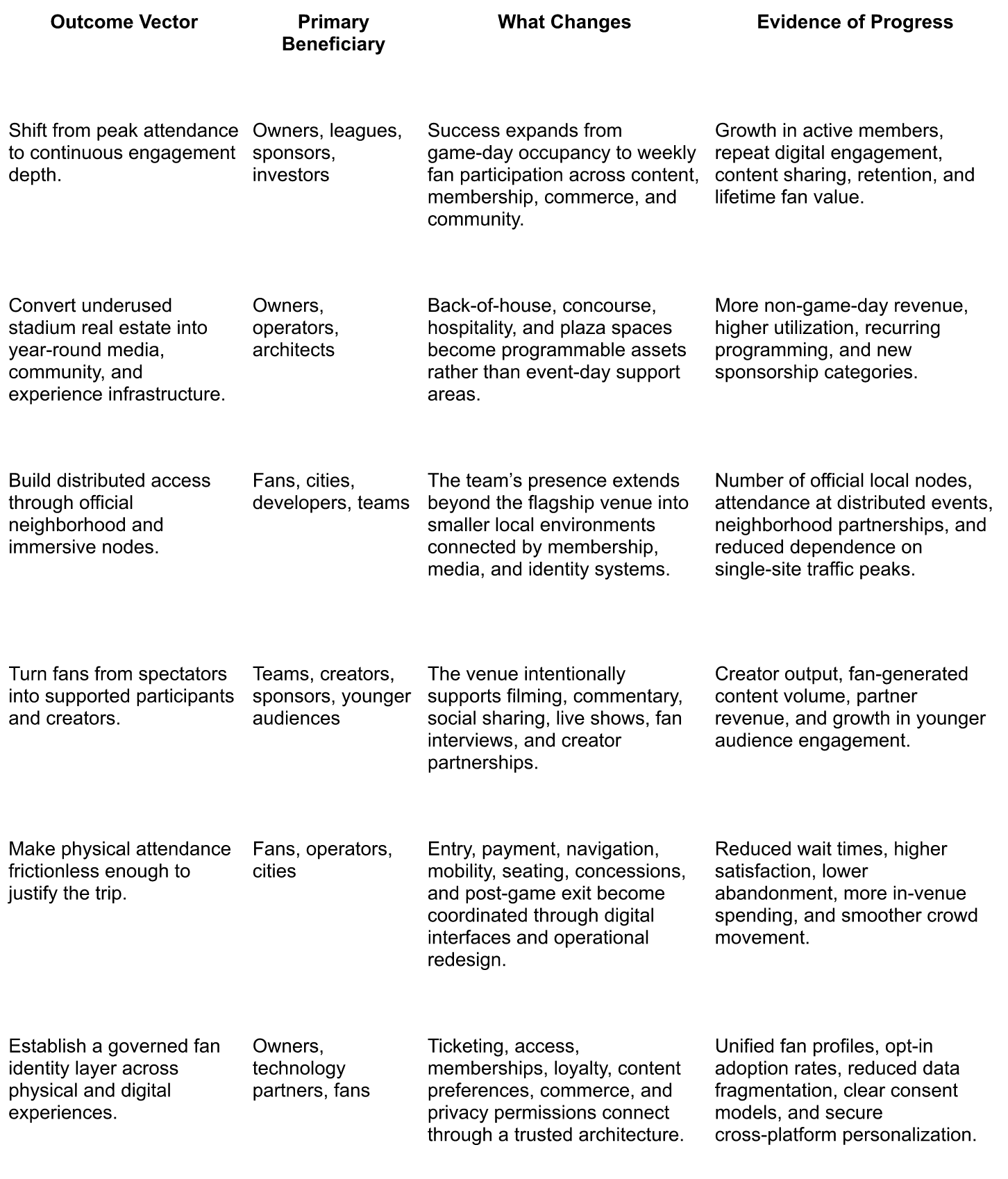
3. Outcome Vectors
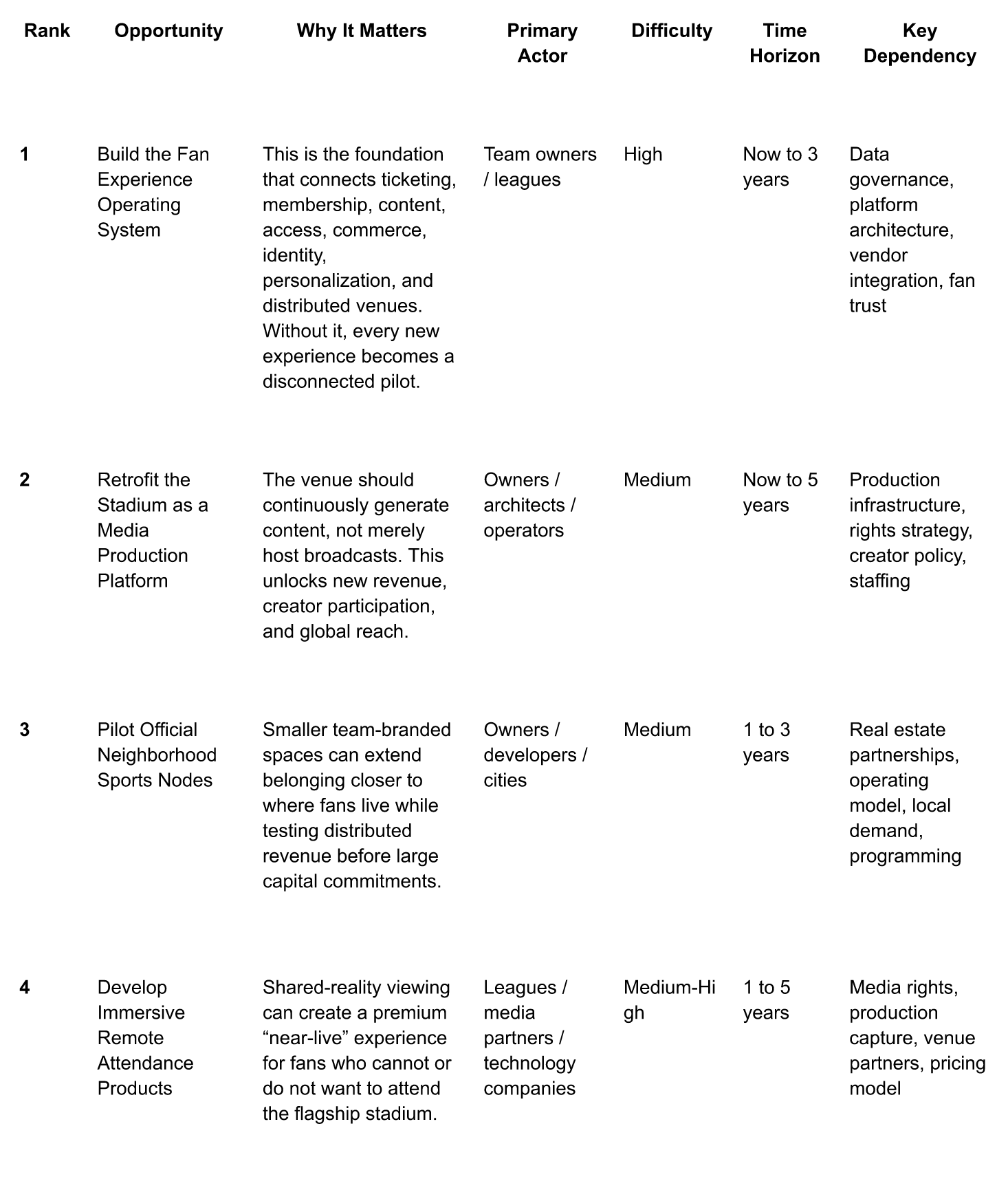
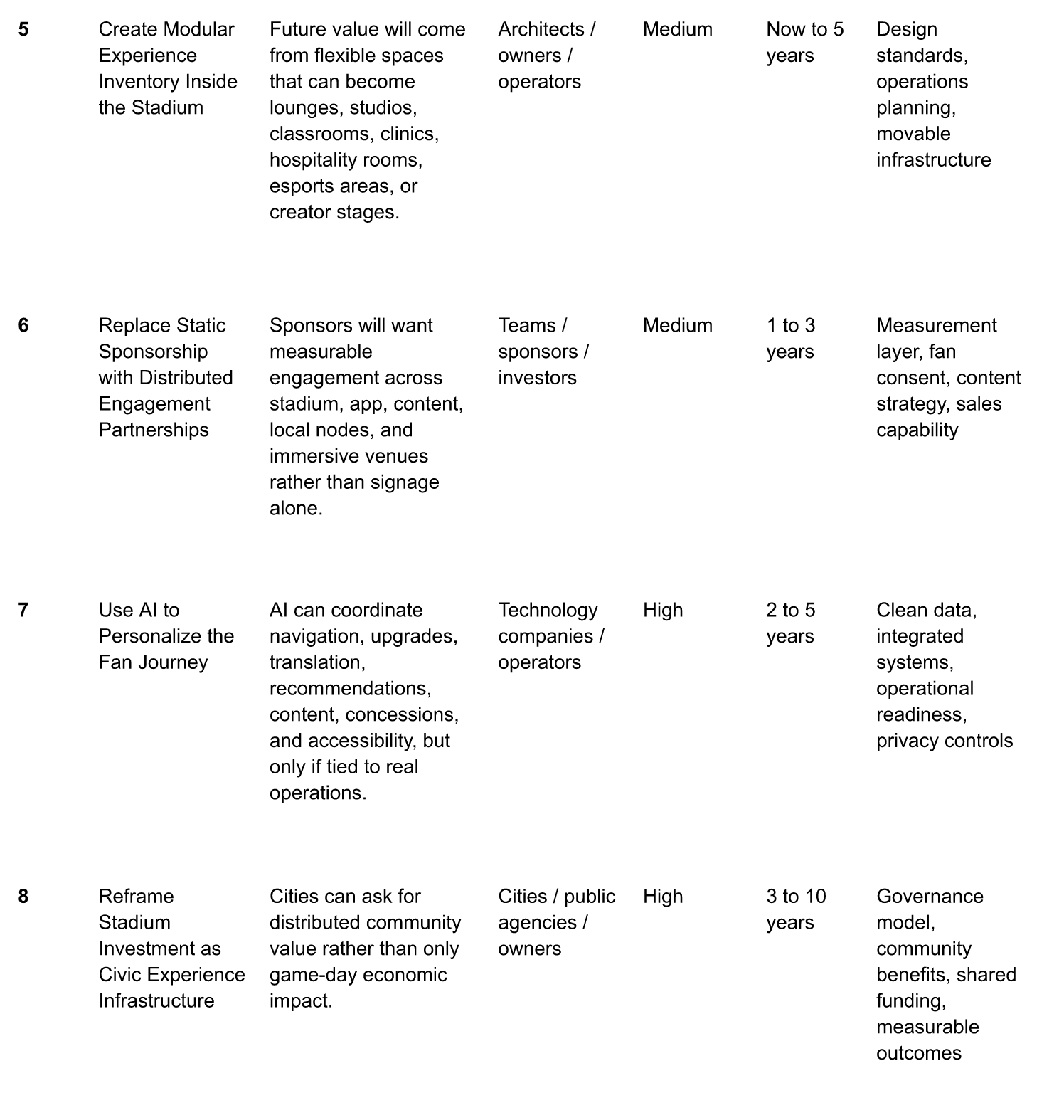
4. Strategic Opportunity Stack
5. Physical-Digital Integration Moves
Spatial Moves
Design the stadium as a flagship node rather than an isolated object.
Convert underused concourse, club, suite, and back-of-house areas into flexible production, hospitality, education, creator, and community spaces.
Add visible media zones where fans, creators, athletes, and sponsors can generate content before, during, and after events.
Create modular social terraces, standing-room neighborhoods, flexible clubs, and convertible rooms that can support multiple levels of participation.
Reserve physical capacity for future cameras, sensors, displays, charging, edge computing, robotics, and mixed-reality systems.
Build smaller official team nodes throughout the region: immersive viewing lounges, youth training spaces, supporter clubhouses, retail-event hybrids, and community sports hubs.
Treat plazas as programmable civic interfaces, not just crowd-holding areas.
Digital Moves
Establish a unified fan identity layer that connects tickets, memberships, loyalty, preferences, permissions, payments, access, content, and commerce.
Build a fan data architecture that supports personalization without creating opaque surveillance.
Integrate mobile apps with wayfinding, concessions, upgrades, transit, parking, digital queues, content, retail, and post-event engagement.
Use AI for recommendations, translation, accessibility support, dynamic offers, crowd prediction, and personalized content assembly.
Develop digital twins for venue operations, crowd flow, energy use, security planning, and event reconfiguration.
Create content systems that can distribute official, creator, and fan-generated media across channels in near real time.
Build membership platforms that allow fans to access the team across stadium events, neighborhood nodes, immersive venues, and digital communities.
Operational Moves
Create a cross-functional experience team that includes venue operations, digital product, media, membership, security, sponsorship, community engagement, and real estate.
Treat creators as operating partners rather than unmanaged visitors. Establish credentialing, access rules, content zones, safety protocols, and revenue-sharing models.
Shift from event scheduling to year-round programming across the stadium, district, neighborhood nodes, and digital channels.
Train venue staff to operate physical-digital experiences, not just manage crowds.
Develop new workflows for distributed events, remote attendance, local watch parties, immersive venues, and hybrid fan participation.
Align security, privacy, legal, and fan experience teams before deploying identity, biometric, or personalization technologies.
Business Model Moves
Move from ticket revenue to experience inventory: memberships, premium remote access, creator partnerships, youth programs, local nodes, digital content, and personalized hospitality.
Build recurring membership tiers that include both physical and digital benefits.
Monetize distributed sponsorship packages across stadium, app, content, neighborhood venues, and immersive experiences.
Treat underused space as a revenue platform for production, events, education, training, clinics, community use, and branded programming.
Use distributed nodes to test demand before committing to larger real estate investments.
Measure value through retention, engagement depth, share of attention, content reach, and lifetime fan value.
Interface Moves
Connect ticketing, access control, security, payments, loyalty, and identity into one governed experience layer.
Ensure venue systems can communicate with mobile apps, content platforms, CRM systems, digital signage, operations dashboards, sponsor platforms, and distributed nodes.
Define who owns fan data, who can use it, how consent is managed, and how fans can opt out.
Build open integration standards where possible to avoid vendor lock-in.
Coordinate with cities and transit agencies so digital journey planning connects with real mobility systems.
Create clear handoffs between league rights, team content, creator activity, sponsor activations, and venue operations.
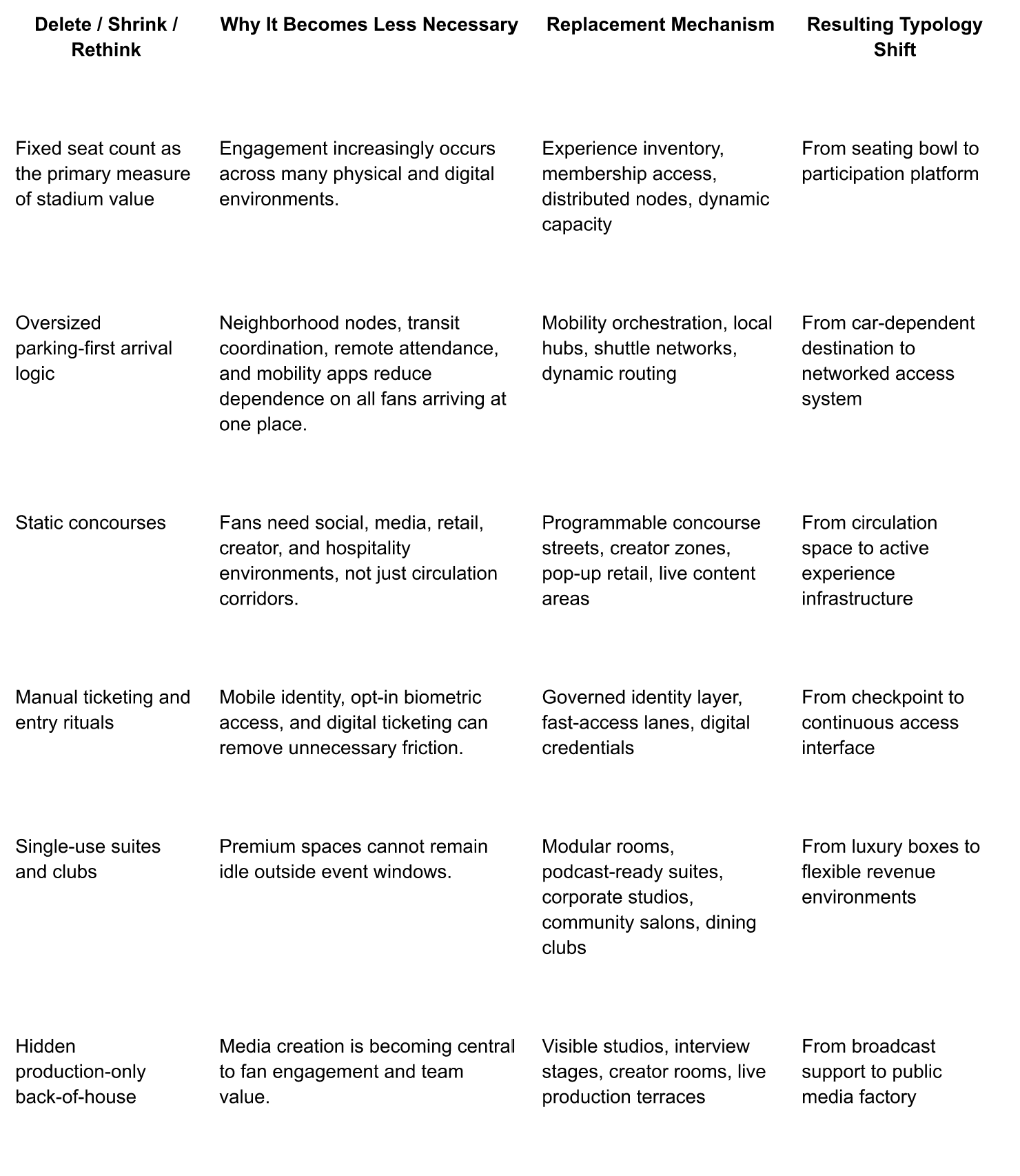
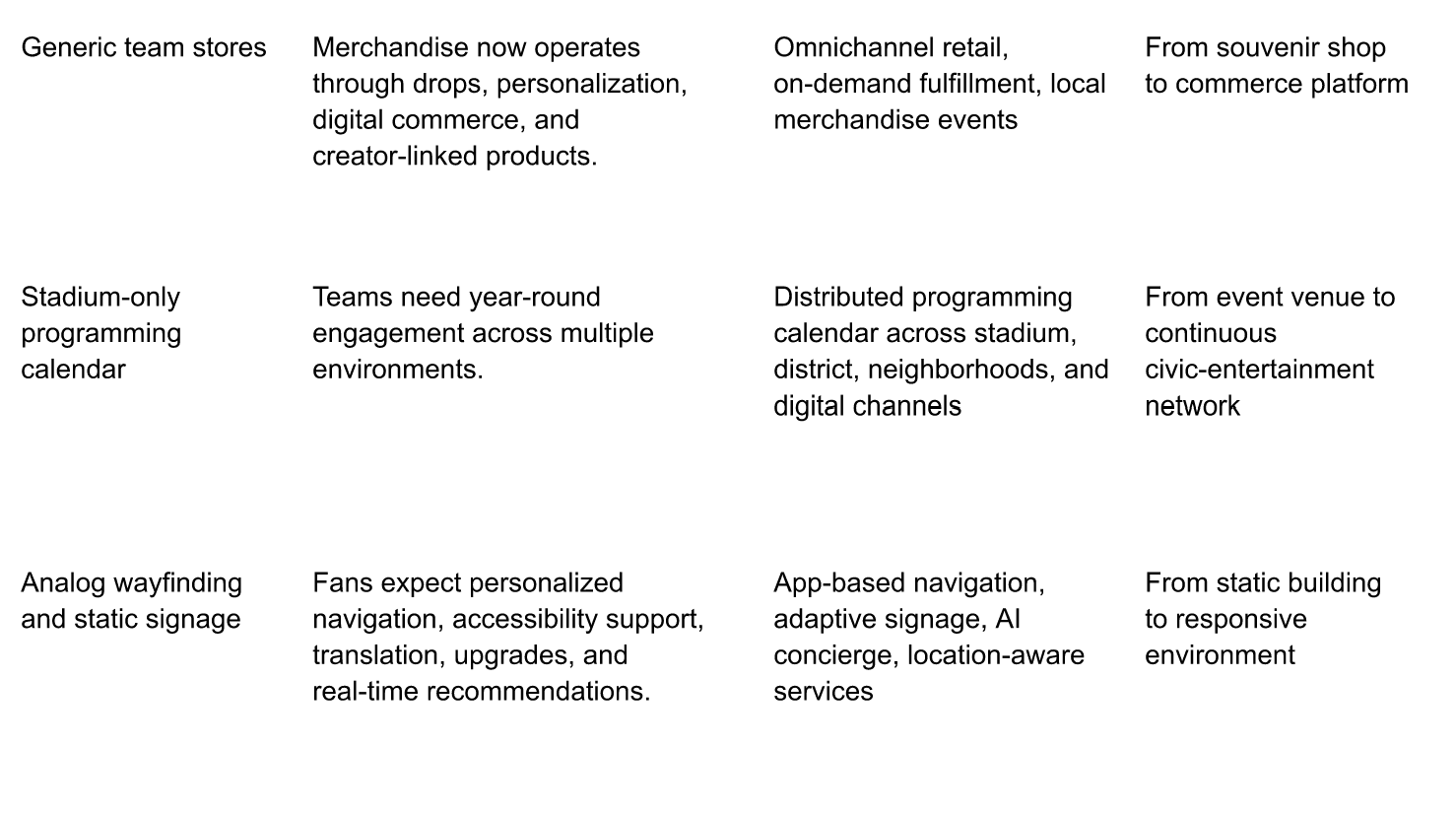
6. Typology Deletions and Replacements
7. Adoption Roadmap
Now
Map the full fan journey across one season: home games, away games, streaming, social media, memberships, merchandise, fantasy, betting, youth programs, travel, and post-game content.
Audit existing fan data systems to identify fragmentation across ticketing, CRM, app, retail, sponsorship, content, and venue operations.
Identify three underused stadium spaces that could become media, creator, community, or flexible hospitality assets within one season.
Pilot one official creator zone with clear access rules, production support, sponsor potential, and fan participation.
Select one neighborhood for a low-cost official team watch hub pilot in partnership with a local venue, developer, school, or community organization.
Define the minimum viable fan identity architecture: membership, permissions, ticketing, content preferences, payments, and privacy governance.
Establish a cross-functional stadium platform team that includes operations, digital, media, security, sponsorship, legal, real estate, and community leadership.
Next
Launch a membership tier that includes both stadium benefits and non-stadium benefits: content, local events, creator access, youth programs, digital community, and priority access to distributed experiences.
Convert one physical area of the venue into a flexible media-and-community room that can host podcasts, fan interviews, sponsor events, small conferences, and non-game-day programming.
Test dynamic upgrades, personalized wayfinding, and digital queue management in one section of the stadium before scaling.
Formalize creator partnerships with a small group of trusted local and national voices. Measure reach, quality, safety, and revenue potential.
Build the operating model for official neighborhood nodes: ownership, branding, staffing, technology, programming, food and beverage, sponsorship, and data capture.
Create design standards for future renovations that require flexible power, data, camera positions, display infrastructure, and modular programming capacity.
Begin city-level conversations around distributed sports infrastructure rather than limiting public-private negotiations to one stadium or district.
Later
Scale from one neighborhood pilot to a regional network of official team nodes, each adapted to local demographics and fan behavior.
Integrate immersive viewing products into memberships, premium packages, corporate hospitality, and away-game experiences.
Reposition the stadium as a year-round production and community platform with dedicated spaces for media, education, wellness, youth sports, esports, corporate events, and civic programming.
Renovate static hospitality and concourse areas into modular experience zones that can change by event type, audience segment, sponsor, or season.
Build AI-driven personalization across the fan journey, but only after governance, data quality, operational workflows, and opt-out mechanisms are mature.
Develop a distributed sponsorship marketplace that values engagement across stadium, app, content, neighborhood nodes, and immersive venues.
Reframe long-term capital planning around adaptability, utilization, media capability, digital infrastructure, and distributed presence rather than only seating capacity.
8. Risk, Dependency, and Governance Map
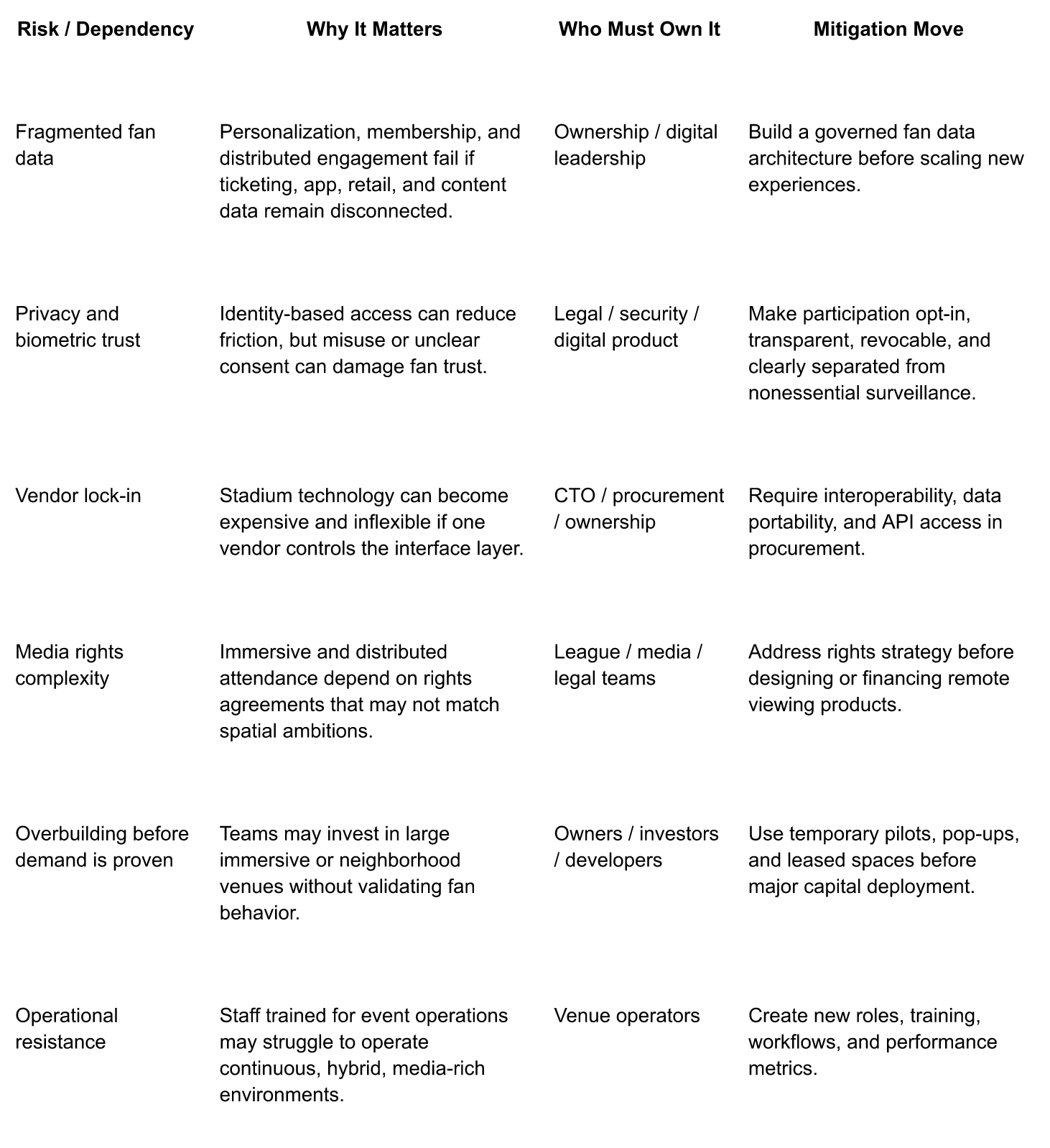
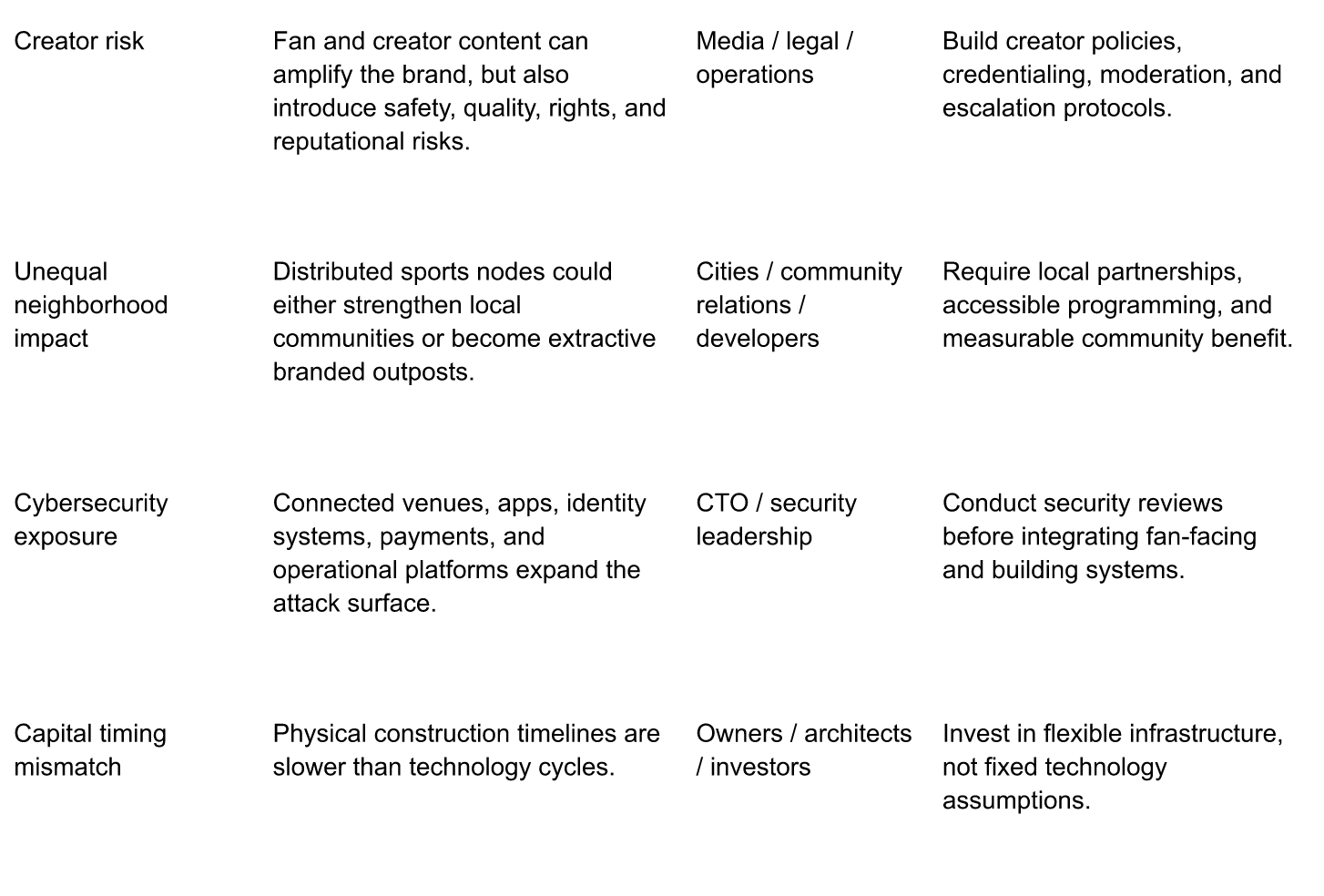
9. Monday-Morning Moves
For Owners
Create a one-page “fan ecosystem map” showing where value is created today: stadium attendance, app use, streaming, social media, merchandise, creators, youth programs, sponsors, memberships, and non-game-day events. Identify which parts you own, which parts partners own, and which parts are unmanaged.
For Architects
Rewrite the stadium design brief around participation rather than attendance. For every major space, ask: Can it host content, community, hospitality, education, membership, media, or distributed programming when the team is not playing?
For Developers / Investors
Model one neighborhood sports node as a real estate prototype: size, location, operating partner, membership tie-in, event calendar, technology requirements, sponsor inventory, and revenue mix. Treat it as a test of distributed demand before underwriting larger projects.
For Cities
Before supporting a stadium or district investment, ask the team to submit a distributed civic activation plan: neighborhood programming, youth access, transit coordination, local business participation, community facilities, and year-round use beyond major events.
For Operators / Institutions
Form a stadium platform team that meets weekly and includes operations, digital product, media, security, guest experience, sponsorship, legal, and community engagement. Give this team authority to redesign the fan journey across physical and digital touchpoints.
For Technology Companies
Stop selling isolated stadium features. Package technology around specific operational problems: faster entry, lower queues, better wayfinding, safer crowd flow, creator enablement, personalized content, distributed membership, or higher utilization of underused spaces.
10. The Non-Obvious Opportunity
The opportunity most organizations will miss is that the future stadium network is not only a way to reach more fans. It is a way to franchise atmosphere. Historically, atmosphere was the one asset that could only exist inside the stadium. Technology is beginning to make atmosphere distributable: not as a replacement for the flagship venue, but as a controlled extension of it. The team that learns how to package identity, ritual, crowd energy, media, membership, and local gathering into repeatable physical-digital nodes will own something more valuable than a building. It will own the operating system for belonging.
Back to TOC
16. Key Takeaways
The live sports experience is not moving away from physical place. It is moving beyond dependence on one physical place.
The stadium remains powerful because it concentrates emotion, ritual, scarcity, identity, and spectacle. But those qualities no longer have to remain trapped inside the venue. Technology allows teams to extend the experience through content, membership, immersive media, neighborhood gathering, creator ecosystems, and personalized interfaces.
The central shift is from attendance to participation.
That shift changes what sports organizations sell. They no longer sell only access to games. They sell belonging in a year-round experience system.
It also changes what architects and developers must design. The future sports venue is not only a bowl, a district, or an entertainment complex. It is a physical-digital platform that supports media, community, identity, commerce, participation, and distributed presence.
The most important question is no longer:
“How many people can we bring to the stadium?”
It is:
“How many meaningful ways can fans participate in the team?”
The organizations that answer that question first will define the next era of live sports. The stadium will still matter. But it will matter differently. It will become the flagship node in a much larger network of places, platforms, people, and rituals that together define the future of fandom.