


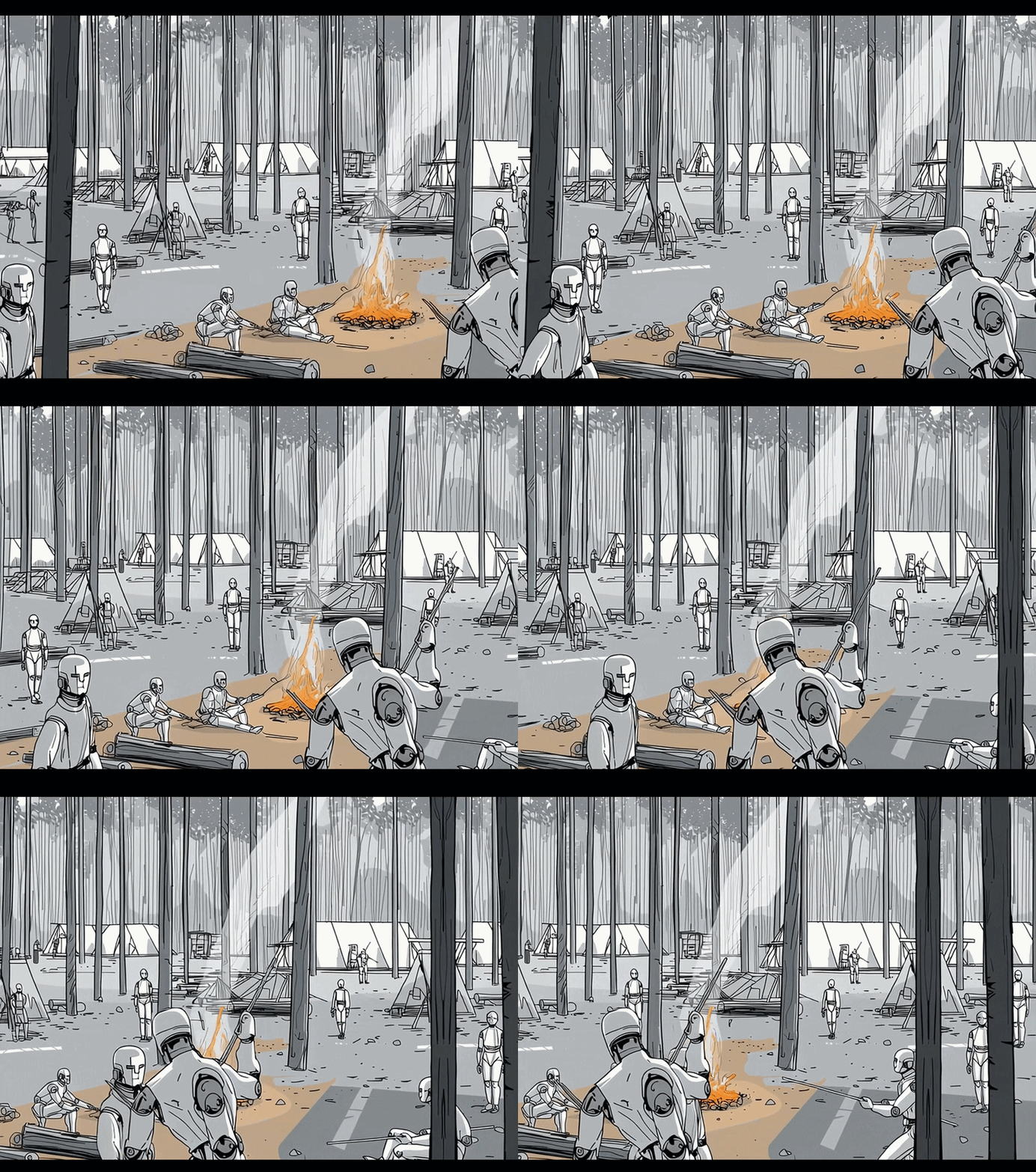
This month in the Ukraine-Russia war, something quietly historic happened.
According to reports, Ukrainian forces captured a Russian position using only ground robots and drones — forcing Russian troops to surrender without a single Ukrainian soldier physically entering the contested area first. President Volodymyr Zelenskyy described it as the first time in history that enemy territory had been seized by unmanned platforms, without troops being directly put at risk.
Politics aside, that should stop us in our tracks.
Because beneath the military headline is a much bigger architectural idea: for the first time, machines became the primary occupants of contested land.
Not support systems. Not tools. Occupants.
That distinction matters. For most of human history, control of land meant physical presence. You occupied territory by being there. You defended cities by standing inside them. You managed buildings by staffing them. Presence meant proximity.
That assumption is breaking.
In Ukraine, drones, robotic ground vehicles, remote operators, and autonomous surveillance created a condition where machines could establish effective control of territory before sustained human occupation. Humans still made the decisions, of course, but the machines became the first physical actors. They entered first, observed first, enforced first, and ultimately made surrender possible.
War often reveals the future before the rest of society is ready to admit it. GPS, the internet, jet engines, satellite communications — all were accelerated by military necessity before becoming ordinary parts of civilian life. Drones and autonomous systems will be no different.
The real lesson here is not about war. It is about habitation.
It is about what it means for a place to be occupied, operated, and controlled. Increasingly, that may happen before humans ever arrive.
I had my own version of this realization years ago while working on the new Hamad International Airport in Doha. At a critical moment, I understood that the airport could not open — not because the building was unfinished, but because the software systems were not ready. The glass, steel, and concrete were waiting on applications, integrations, and operational systems. The physical world was waiting on the digital world.
That was the moment architecture changed for me: the digital world trumped the physical world.
At the time, that felt like a revelation specific to airports. Today, it feels like a condition of civilization.
Ukraine pushes that realization one step further. What if the digital world does not simply support the physical world — what if it occupies it first?
We are already moving in that direction, only more quietly. Remote airport security screening. Autonomous warehouses. Robotic hospital logistics. Drone inspections of bridges and power infrastructure. Self-driving vehicles. Remote operations centers. Smart buildings that diagnose problems before a technician arrives.
We are entering an era where operation and occupancy are no longer the same thing.
A place may be actively governed long before it is physically populated. Machines may not be the only inhabitants, but they may increasingly be the first and most important ones.
This creates a design problem that architects are barely talking about.
We still tend to think of buildings as places for humans first, with technology layered awkwardly on afterward. We design the architecture, and then we let the systems people figure out where to put the devices.
But what happens when the building is designed first for machines that support humans?
Where do drones dock? How do inspection robots move vertically through a hospital or terminal? What does a rooftop become when it is active robotic territory instead of leftover roof area? How should an airport function when autonomous vehicles define circulation before passengers do? What does domestic privacy feel like when surveillance is ambient, autonomous, and always overhead?
These are not futuristic questions. They are present-tense design questions.
I have spent a great deal of time obsessing over one version of this problem through the idea of the Autonomous Decentralized Airport — an airport where passengers bypass the traditional terminal and instead move through a distributed terminal zone orchestrated by autonomous vehicles, e-gates, and digital systems. No giant concourse. No centralized holdrooms. No terminal as we know it. The machine network becomes the architecture, and passengers simply move through it.
When I first started thinking about it, the idea felt speculative. Now it feels inevitable.
Because the real question is not whether autonomous districts will exist. It is what happens when the first one becomes economically better than a human-operated one.
An airport. A port. A logistics campus. An industrial district.
Once that happens, adoption will not be driven by futurism. It will be driven by usefulness.
And that is always how the future arrives.
When most people imagine cities run by machines, they reach for dystopian science fiction — Terminator 2: Judgment Day, Skynet, the familiar fantasy of machines eliminating humans. That framing is emotionally understandable, but strategically lazy.
The real future will not arrive like a movie villain. It will arrive like convenience.
It will look like fewer delays. Better reliability. Lower operating costs. Fewer repetitive human tasks. Less friction.
The most disruptive technologies rarely arrive looking dangerous. They arrive looking useful.
That is why architects cannot rely on dystopian fiction to think for us. We need better design fiction for ourselves — plausible futures we can test, critique, and shape before they become reality. If we only imagine the future through fear, we surrender our role in designing it.
This is why I believe architects must pay far more attention to cultural technology, not just design technology.
Not BIM. Not rendering software. Not better ways to draft.
I mean the technologies actually reshaping how society lives: AI, autonomy, robotics, identity systems, mobility platforms, networks, spatial computing.
These are the forces that create and destroy typologies.
Shopping malls collapse because of e-commerce. Ghost kitchens emerge because of delivery networks. Offices change because of remote work. Data centers become essential because the cloud has a physical address. Airports evolve because identity, movement, and logistics become digital problems before they are architectural ones.
These are not technology stories with architectural consequences.
They are architectural stories.
Vitruvius had fire. Sullivan had steel and elevators. We have AI, robotics, and machine intelligence.
The question is not whether these technologies will shape architecture. They already are.
The question is whether architects will lead that conversation — or simply decorate the outcome.
Architecture has always been about more than buildings. It has been about understanding where civilization is headed and making that future inhabitable.
That responsibility is even greater now because the technologies shaping the next century are increasingly invisible. Networks. Algorithms. Autonomous systems. Machine intelligence.
They do not look like architecture.
But they determine it.
If machines can take territory before humans arrive, they can certainly reshape how cities, buildings, and infrastructure are designed.
Architects should be among the first to think about that.
Not after.
First.