



You can download a PDF of the full report here:

Table of Contents
03. The Runways Are Already Here
06. Design the Invisible Building First
07. The Airport Is Bigger Than the Airport
09. When the Protocol Becomes Architecture
12. What Could Kill This Future?
13. Innovation Architect Action Brief™
01. Friday Afternoon, 2033

At 11:07 on Friday morning, Maya gets a notification.
Napa this weekend?
Two seats have opened on the 4:10 flight north. A hotel she saved months ago has availability. The weather looks good. A cooking studio she follows has two places left Saturday morning.
Underneath is a single number.
Weekend for two: $1,684.
Flight. Hotel. Taxis. Cooking class. Saturday wine itinerary. Return Sunday.
The flight leaves from Santa Monica, five minutes from home. Pickup is scheduled for 3:28.
She presses Book.
That is almost the last decision she makes.
At 3:27, a vehicle pulls up outside. The ride already knows the itinerary. By the time Maya reaches the airport, the flight knows she has arrived.
The XBO is smaller than she expected: one staffed desk, perhaps thirty chairs, a café and a wall of glass facing the aircraft. A camera confirms her identity as she enters. Her bag disappears through a side door.
Boarding begins in twelve minutes.
There is enough time for an espresso.
The café is busy, although not entirely with passengers. Several people at the long table appear to be local. A small group has gathered near the ramp for an aircraft demonstration later that afternoon. Dinner service starts at five.
The room feels less like a terminal than a place that happens to have airplanes outside.
At 3:58, Maya’s itinerary changes color.
Board when ready.
No gate number.
The airplane is sixty feet away.
Minutes later, the city begins falling away beneath them. The coastline appears through the window. Roads, neighborhoods and beaches collapse into geography.
Maya knows her flight is quieter and cleaner than a typical airplane. She knows a complicated energy system sits beneath the simplicity of the flight.
But she is not thinking about propulsion.
She is thinking about dinner.
The weekend has already begun.
Twenty minutes before landing, Napa starts rearranging itself around their arrival.
Their room is confirmed. Ground transportation sees the aircraft’s updated arrival time. Dinner remains where it was. The cooking class stays on Saturday morning.
The system asks one question:
Go directly to hotel, or stop for a late-afternoon tasting?
They choose the tasting.
Maya’s bag does not follow her off the aircraft. It goes to the hotel.
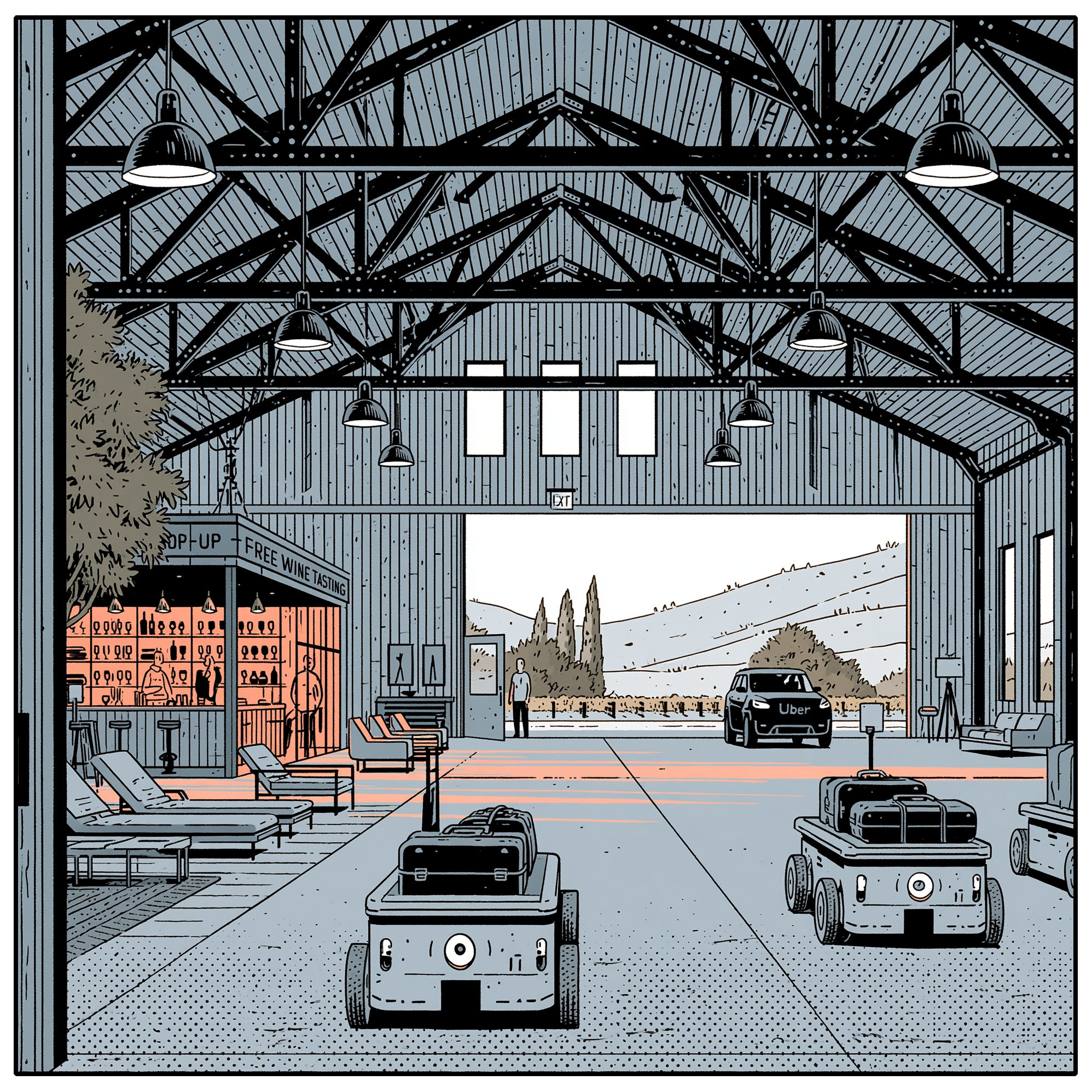
The Napa XBO feels familiar but different from the one they left. The identity, itinerary and operating logic are the same. The place is unmistakably Napa.
A producer is pouring wine at a temporary tasting bar. Bottles from nearby vineyards sit beside information about weekend events. Some people in the room are waiting for flights. Others are not flying anywhere.
Maya’s phone vibrates.
Your ride is here.
They never have the same vehicle twice that weekend. It does not matter. Their trip includes mobility through Sunday afternoon, so transportation appears when they need it.
No rental counter. No keys. No parking. No deciding who can have wine with lunch.
Saturday’s cooking class runs long. The first winery reservation shifts. The next ride shifts with it. Rain arrives late in the afternoon, so an outdoor tasting is replaced with an indoor option nearby.
They approve the change while still in the car.
They never open a map.
By Sunday morning, Maya realizes how little time they have spent thinking about the airport.
The system has been present almost continuously, but mostly as connective tissue. It coordinated flight, transportation, luggage, hotel, reservations and changes while allowing the physical experience at each end to behave differently.
At home, the XBO nearly disappeared. Its job was to get them from the street to the aircraft quickly.
In Napa, it expanded into the destination.
Same network.
Different place.
Their return flight is delayed thirty-eight minutes.
A few years earlier, that might have meant checking out on time and sitting at the airport anyway.
Instead, checkout moves. Their pickup comes later. The bag still reaches the aircraft before they do.
They arrive twenty minutes before boarding.
Maya buys a bottle from a producer they visited the day before. The restaurant is full. Outside, aircraft are plugged in while vehicles cycle through the mobility court.
The technology is visible.
But it is not the point.
The point is the weekend.
At 6:26, the aircraft lifts away from Napa.
Maya opens the app.
Under Next Adventure, three journeys are waiting.
Monterey.
Santa Ynez.
Tahoe.
She saves two.
The system has done something more consequential than make an airport efficient.
It has given her a reason to travel again.
Back to TOC
02. The Point Is the Weekend
Maya did not book an airplane. She booked Napa. That distinction is the premise of this Edition.
Most arguments about the future of regional aviation begin with propulsion: batteries, emissions, noise, range, operating cost or certification. Those things matter because they may determine whether new forms of regional flight become commercially viable.
But they are unlikely to be why anyone wants the trip.
People do not plan weekends around battery chemistry. They plan them around Napa, Big Sur, the mountains, a restaurant, a concert, a game, a wedding or friends they have not seen in months.
Technology matters when it changes the effort required to reach those things.
This Edition uses the term Electric Adventure for a possible category of travel in which increasingly quiet and lower-emission regional flight combines with low-friction airports, on-demand ground mobility, and digitally coordinated destination services to make the journey itself part of the experience.
The environmental proposition matters. So does arriving in an hour instead of spending much of a day driving. So does walking toward an aircraft rather than spending the beginning of a weekend inside a terminal. So does not renting a car. So does deciding on Friday morning that leaving Friday afternoon is still realistic.
The significant change is not speed alone. It is friction.
A six-hour drive changes the threshold for taking a trip. Conventional air travel can save driving time while adding different burdens: travel to a large airport, parking, processing, waiting, baggage and another transportation problem after landing.
A regional journey becomes more interesting when enough of those penalties disappear together. That raises a more consequential question than whether regional aviation can capture trips people already make:
Could a new form of mobility cause people to take trips they do not make today?
Transportation planning usually assumes demand exists first. People want to move from A to B; the transportation system competes to serve that movement. Electric Adventure suggests that demand can also run in the opposite direction.
Sometimes the mobility creates the trip. A destination that feels inconvenient at six hours away can feel spontaneous at one. A Friday afternoon that used to be too late to leave can become early enough.
That does not mean every regional flight creates new demand, or that travelers will pay any price for a better experience. The thesis has to survive behavior.
Do people book? Do they return? Do they add lodging, transportation, dining and experiences to the journey? Most importantly, do some of those trips exist because the mobility made them attractive enough to take?
If the answer is yes, even in particular markets, regional airports acquire a different kind of value.
The question is no longer only how many people live within driving distance of a runway. It is also what that runway puts within reach.
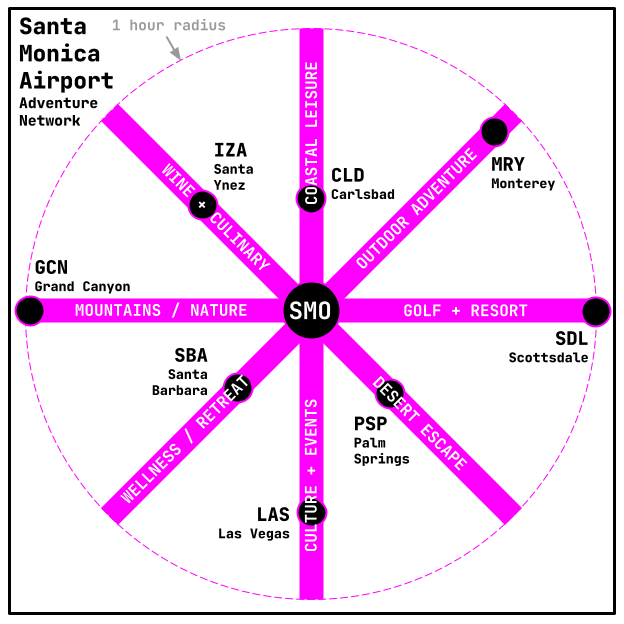
The airplane is only one part of that proposition. A one-hour flight followed by a forty-minute transportation problem has not solved the journey. The destination has to become accessible too.
Electric Adventure is therefore less a theory about airplanes than a theory about behavior: whether technological change can lower the effort of regional travel far enough that spontaneity returns.
If that sounds ambitious, the surprising part is how little of the physical network needs to be invented from scratch.
Back to TOC
03. The Runways Are Already Here
Across the United States, regional and general-aviation airports occupy land that would be extraordinarily difficult to assemble today. They have runways, airspace access, operating systems and established relationships to cities and destinations.
Many sit close to places people already want to go. What they often lack is relevance, not infrastructure.
For most travelers, aviation means large commercial airports. Regional and general-aviation facilities sit outside that mental map unless someone owns an aircraft, charters one, trains as a pilot or lives in a community with smaller-scale air service.
Yet the physical network already exists.
That creates a different starting point from visions of advanced mobility built around thousands of new vertiports or specialized landing sites. Conventional-takeoff electric and hybrid-electric aircraft suggest that at least part of the next regional network could use infrastructure already on the ground.
The runway may be the hardest part of the future airport to create. The building: not so much.
A useful precedent has existed beside those runways for decades: the fixed-base operation, or FBO.
FBOs primarily serve private and general aviation, but they demonstrate something important about passenger architecture. A traveler can arrive shortly before departure, walk through a small facility, see the aircraft outside and board only steps away.
That directness is not simply luxury. It is evidence that many characteristics people associate with “air travel” are consequences of a particular operating model rather than permanent requirements of flight.
JSX provides a contemporary commercial signal. Its customers on most domestic flights are currently told to arrive only 20–30 minutes before departure, and the company describes a roughly twenty-minute curb-to-seat experience through smaller facilities.
The aircraft does not need to become electric before regional flying can feel different.
That matters because passenger experience and propulsion can evolve independently. If they eventually reinforce one another, the opportunity becomes larger.
Regional aviation also has a reason to search for new economics. A June 2026 U.S. Government Accountability Office analysis found that average daily departures per route at nonhub airports were 19 percent lower in 2024 than in 2018, while more than 70 percent of nonhub airports outside the Essential Air Service program experienced declines (Source).
Small routes are difficult. Labor is expensive. Aircraft economics reward scale. Communities can lose service while the runway remains.
That creates an unusual condition: scarce physical infrastructure already exists in places that the conventional airline model may struggle to serve.
A different operating model could value those airports differently. Not because their terminals are large, but because of where the runway is.
Close to a neighborhood. Close to a university. Close to wine country. Close to the coast. Close enough that an hour in the air changes what someone considers possible for the weekend.
The United States may not need to invent an entirely new geography of regional aviation before testing a new regional travel system. It may need to look differently at the geography it already has.
Back to TOC
04. What Changed
No single breakthrough makes Maya’s weekend plausible. The opportunity comes from several systems that developed separately beginning to overlap.
Flight
Electric aviation remains early. Certification, payload, reserves, charging, capital cost, maintenance and real-world operating economics remain unresolved at commercial passenger scale.
But the signals are no longer purely conceptual.
BETA Technologies is developing its all-electric ALIA conventional-takeoff-and-landing aircraft around ordinary airport infrastructure. Heart Aerospace is pursuing a 30-passenger hybrid-electric regional aircraft and, in August 2026, flew its full-scale X1 battery-electric demonstrator from Plattsburgh International Airport.
Neither example proves that mature electric regional aviation has arrived. They show that developers are testing new propulsion at the scale and in the airport environments relevant to regional flight.
The useful signal is not a winner. It is that the aircraft itself is becoming variable again.
Passenger Experience
While future aircraft remain uncertain, low-friction regional operations already exist in partial form.
JSX demonstrates that a smaller-scale passenger journey can separate flight from much of the conventional terminal experience. Its agreement for future Heart ES-30 aircraft is notable not because those aircraft are guaranteed to define the market, but because it connects two previously separate trajectories: a new passenger operating model and a new aircraft platform.
Ground Mobility
The old regional-airport answer after landing is often a rental car. Networked mobility loosens that assumption.
Ride-hailing, private transportation, hotel vehicles and shuttles already allow travelers to buy rides without owning or renting the vehicle providing them. Autonomous mobility could eventually extend that model; Waymo already operates fully autonomous ride-hailing in several U.S. cities and has expanded airport access in places including Phoenix and San José.
The architectural implication is not that rental cars disappear tomorrow. It is that mobility can increasingly be purchased as access rather than possession.
Identity
Passenger identity is also becoming more digital. TSA’s PreCheck Touchless ID program is available at dozens of U.S. airports.
Security does not disappear when identity becomes digital. But some acts of verification may no longer require the same physical ritual. Information problems that once became counters, documents, and queues can begin moving into networks.
Energy
Electrified aircraft and vehicles create the opposite effect: they make some invisible systems more physical.
Charging speed affects aircraft turnaround. Grid capacity can affect fleet scale. Storage can affect resilience. Multiple aircraft and vehicle types may compete for electrical capacity. Energy therefore moves upstream into airport planning.
Orchestration
The least visible shift may be the most consequential.
The airline knows the flight. The mobility provider knows the ride. The hotel knows the room. The restaurant knows the reservation. The traveler’s phone knows payment, location and preference.
Today, those systems remain fragmented. When one changes, the traveler still does much of the integrating.
The technical components required to coordinate more of that work — APIs, permissions, digital identity, payment systems, dispatch platforms, itinerary engines and increasingly capable AI — already exist in pieces.
What does not yet broadly exist is the operating model that treats them as one journey. That is the important convergence. Aircraft can change. The airport experience can change. Mobility can become access. Identity can migrate digitally. Energy can become a strategic infrastructure layer. Software can coordinate activities previously separated by organizational boundaries.
The pieces remain incomplete and uncertain, but they are no longer imaginary. The design question is therefore not which technology wins, but rather:
What becomes possible when these systems begin behaving like one?
Back to TOC
05. Meet the XBO
The missing piece is an operating model capable of making the parts of a regional journey behave as though they belong to the same system.
We call that model the Experience-Based Operation, or XBO. The name borrows from the fixed-base operation, but the organizing principle changes. An FBO serves aviation. An XBO serves the journey.
The conventional aviation transaction is largely bounded by the airport:
airport → aircraft → airport
The trip people actually care about is larger:
home → regional airport → flight → mobility → lodging → experiences → mobility → flight → home
The XBO organizes around the second sequence. It does not have to own every component. Aircraft operators can fly the aircraft. Hotels can operate hotels. Mobility companies can provide transportation. Restaurants and destination businesses can provide the experiences.
The XBO’s role is to make those assets behave like one product. That makes it more than a premium FBO. Better lounges and concierge service improve the place through which the traveler passes; the XBO extends into the journey beyond the property line.
It is also more than a travel app. Digital coordination becomes architecturally consequential when it touches physical airport operations: the place where the vehicle stops, the bag changes hands, the aircraft connects to energy, the passenger crosses an airside boundary or a failed automated process becomes somebody’s problem.
This leads to this Edition’s central typological proposition:
The XBO is a protocol before it is a place.
The first XBO may not require a purpose-built building. It could begin inside an existing FBO or regional airport through partnerships, operating procedures, a coordinated itinerary, reliable ground mobility, baggage protocols, digital interfaces and modest physical interventions.
That changes the design sequence. Instead of assuming the future requires a lounge, check-in desk, rental counter, baggage claim or particular charging system, begin with a different question:
What functions will the future journey require — and which of them still need to be rooms?
The architecture follows where the operating model repeatedly encounters the physical world. That makes the XBO potentially scalable without making it placeless. The journey protocol can remain consistent across the network, whereas the buildings should not. Napa should not look like Monterey. Monterey should not look like Santa Ynez.
In other words:
Standardize the protocol. Localize the place.
Back to TOC
06. Design the Invisible Building First
Before drawing the XBO, map what has to know what.
A restaurant knows a reservation time. A mobility provider knows where to send a vehicle. A hotel knows the arrival date. The aviation operator knows the aircraft schedule.
The problem appears between them. Those gaps are where the traveler still performs the integration. The first architecture of the XBO is therefore a map of relationships.
The XBO Operating Stack
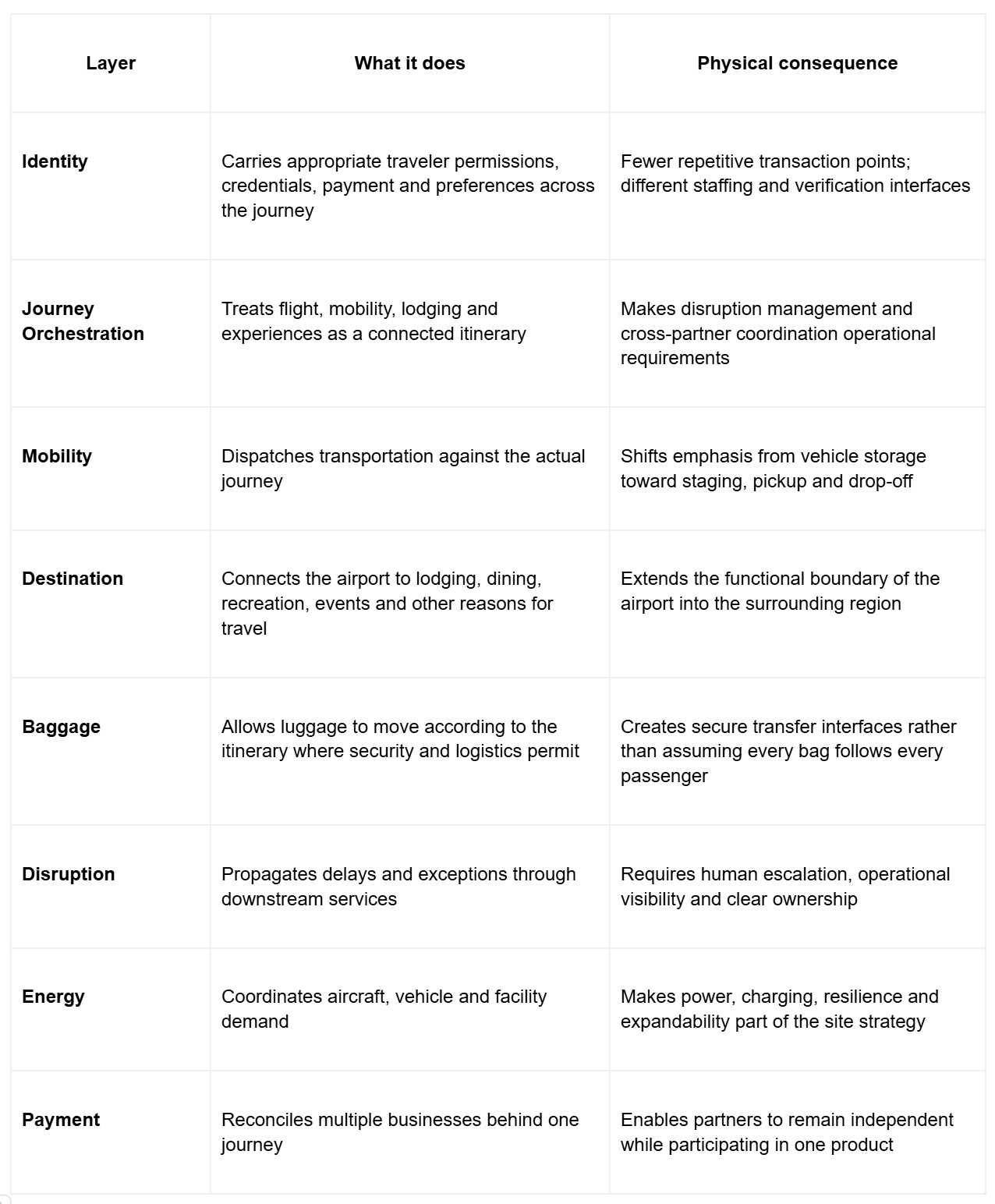
The strategic requirement is not that one company own everything. It is that the journey behave like one system even when the businesses providing it remain separate. That makes interoperability part of the architecture.
It also makes exception ownership critical. A journey that feels effortless during ideal conditions is not enough. Flights are delayed. Vehicles miss pickups. Weather changes. Reservations cannot move. Charging systems fail.
Some responses can be automated, but others require people. At every transition, someone must know who owns the failure. That is why the most important design object in the XBO is often not the room — it is the handoff:
traveler ↔ identity
traveler ↔ aircraft
aircraft ↔ energy
traveler ↔ mobility
bag ↔ logistics
flight ↔ destination itinerary
digital platform ↔ human operator
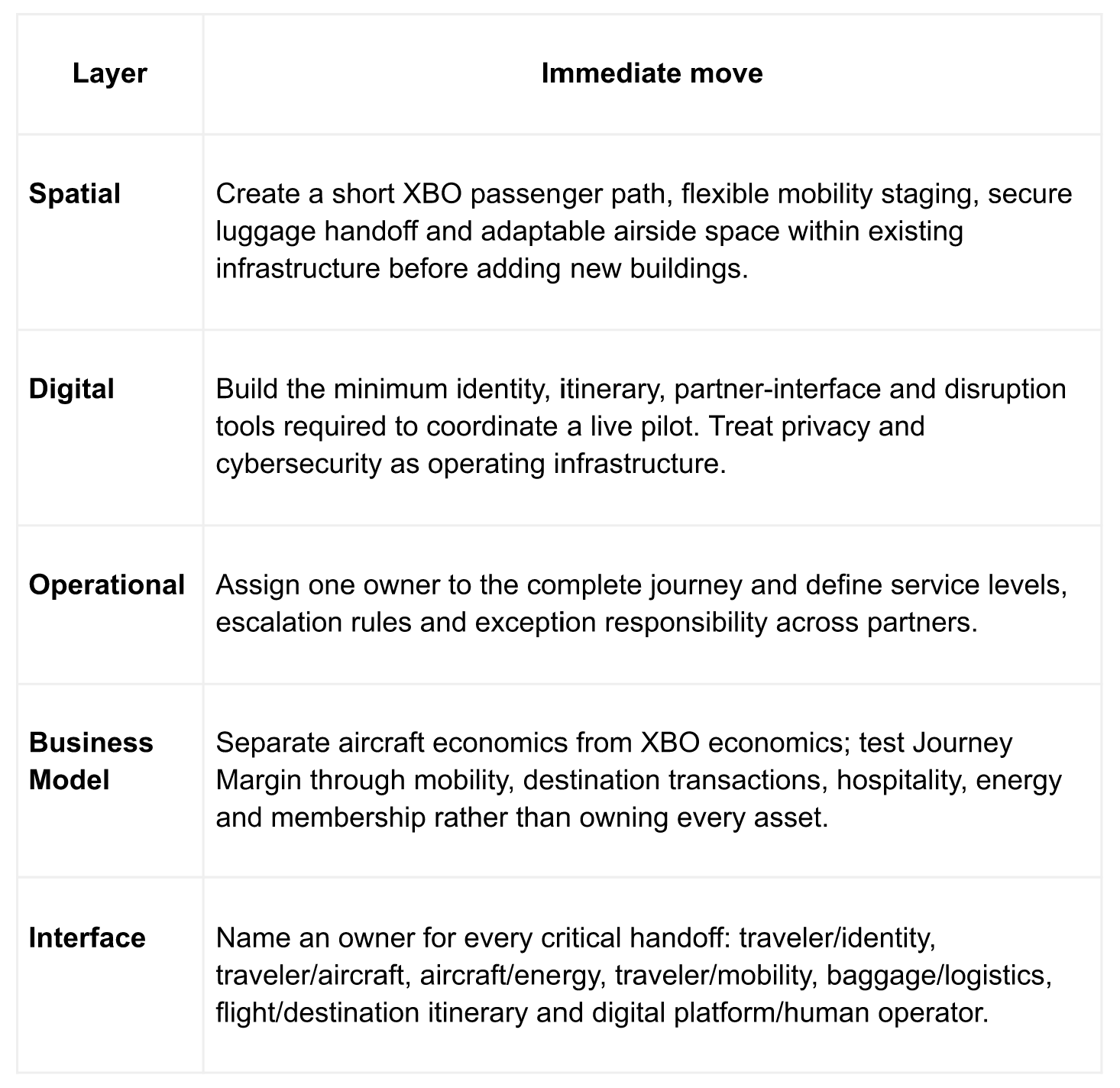
Each has a physical location, digital logic and operating owner. This is where software becomes useful as a pre-architectural tool. It exposes which activities can move into networks, which require resilient human support and where the physical world refuses to disappear.
The invisible building is not a replacement for architecture. It is a way to understand the operation before freezing it into space.
Back to TOC
07. The Airport Is Bigger Than the Airport
Airports are traditionally evaluated through a catchment area: how many people and how much economic activity sit within reasonable access of the runway?
Electric Adventure adds another geography.
Not only:
Who can reach this airport?
But:
What can this airport allow someone to reach?
We call this the Experiential Catchment Area: the collection of desirable places, activities and experiences that become realistically accessible through an aviation node.
Wine regions. Coastlines. Mountain communities. Resorts. Universities. National parks. Restaurants. Sporting events. Cultural districts. Outdoor recreation.
A runway does not need to sit beside a large population to be strategically interesting. It can also sit beside something people strongly desire.
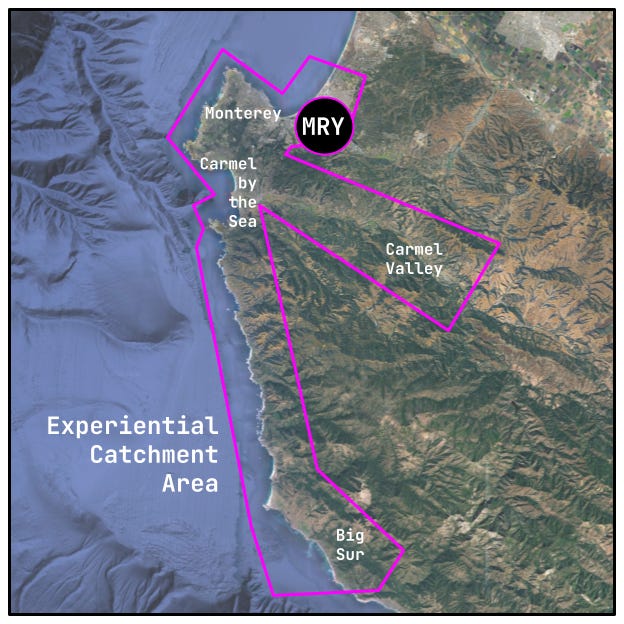
But proximity alone is not enough.
A great destination can still produce a bad journey if transportation is unreliable, lodging and reservations remain fragmented or local businesses have no way to participate in the network.
The useful question becomes:
How easily can what exists nearby behave like a journey?
Call that quality Experience Orchestrability.
Together, these ideas suggest that the corridor — not the airport alone — is the better unit of analysis. A promising XBO corridor combines:
strong access to travelers at the origin;
a desirable Experiential Catchment;
enough transportation and destination connectivity to orchestrate the trip;
aircraft that fit the airport and route;
infrastructure that can adapt without premature capital;
and partners willing to coordinate.
Thinking in corridors also reveals a useful spatial duality. To the departing traveler, the ideal XBO almost disappears. Arrive, confirm identity, hand off the bag, board. To the arriving traveler, that same node becomes a gateway to the surrounding region.
Departure compresses the place. Arrival expands it.
That distinction can change airport real estate.
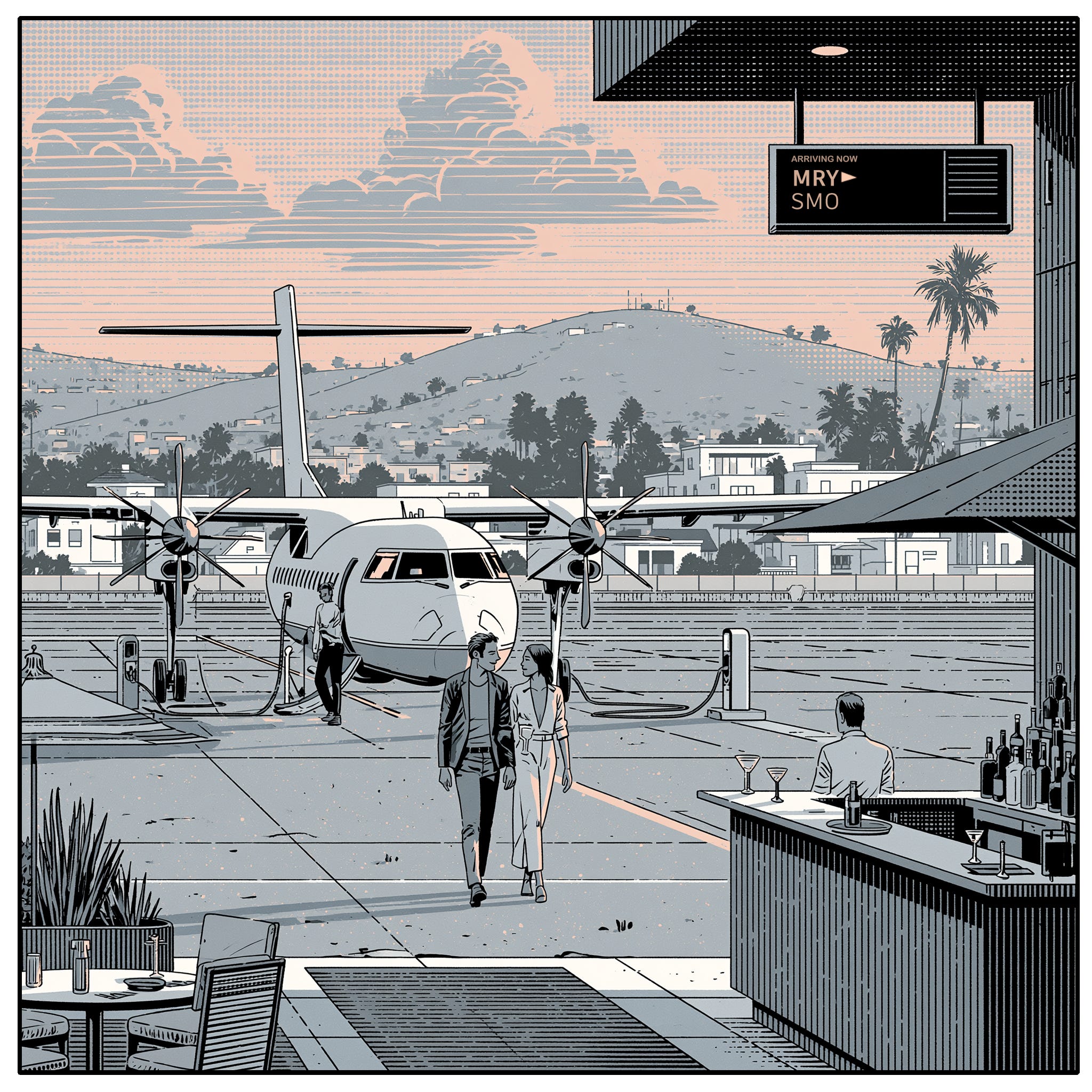
A restaurant overlooking the runway may have little value to a departing traveler who spends fifteen minutes in the building. It may have substantial value to someone arriving for the weekend — or to residents who are not flying anywhere.
Events, local food, hospitality and community programming could make selected XBOs two-sided places: efficient transportation nodes for departing travelers and points of exchange for arriving visitors and nearby residents.
Not every airport needs those uses. They have to earn their place too. But once the airport is understood as a node inside a wider experiential network, its property line becomes a poor definition of its value.
The runway is the infrastructure. The Experiential Catchment is the opportunity.
Back to TOC
08. Earn the Building
The conventional development sequence is familiar:
program → design → build → operate → learn
The XBO creates an opportunity to reverse it.
operate → observe → learn → build
Because its first innovation is operational, an XBO can begin inside infrastructure that already exists. Call that the Minimum Viable XBO.
A first version could combine an existing aviation node, a basic journey-orchestration layer, a small destination partner network, reliable ground transportation and only the physical interventions required to make the service work.
The purpose is not to demonstrate architecture — it is to demonstrate behavior.
Do people choose the journey? Do they take it more often? Do they attach mobility, lodging and experiences? Does the ground network preserve the time advantage created in the air? Can the partners coordinate without creating excessive operational burden? What are travelers willing to pay for?
Those questions become a new kind of programming study.
The Pilot Is the Programming Study
Useful metrics include:
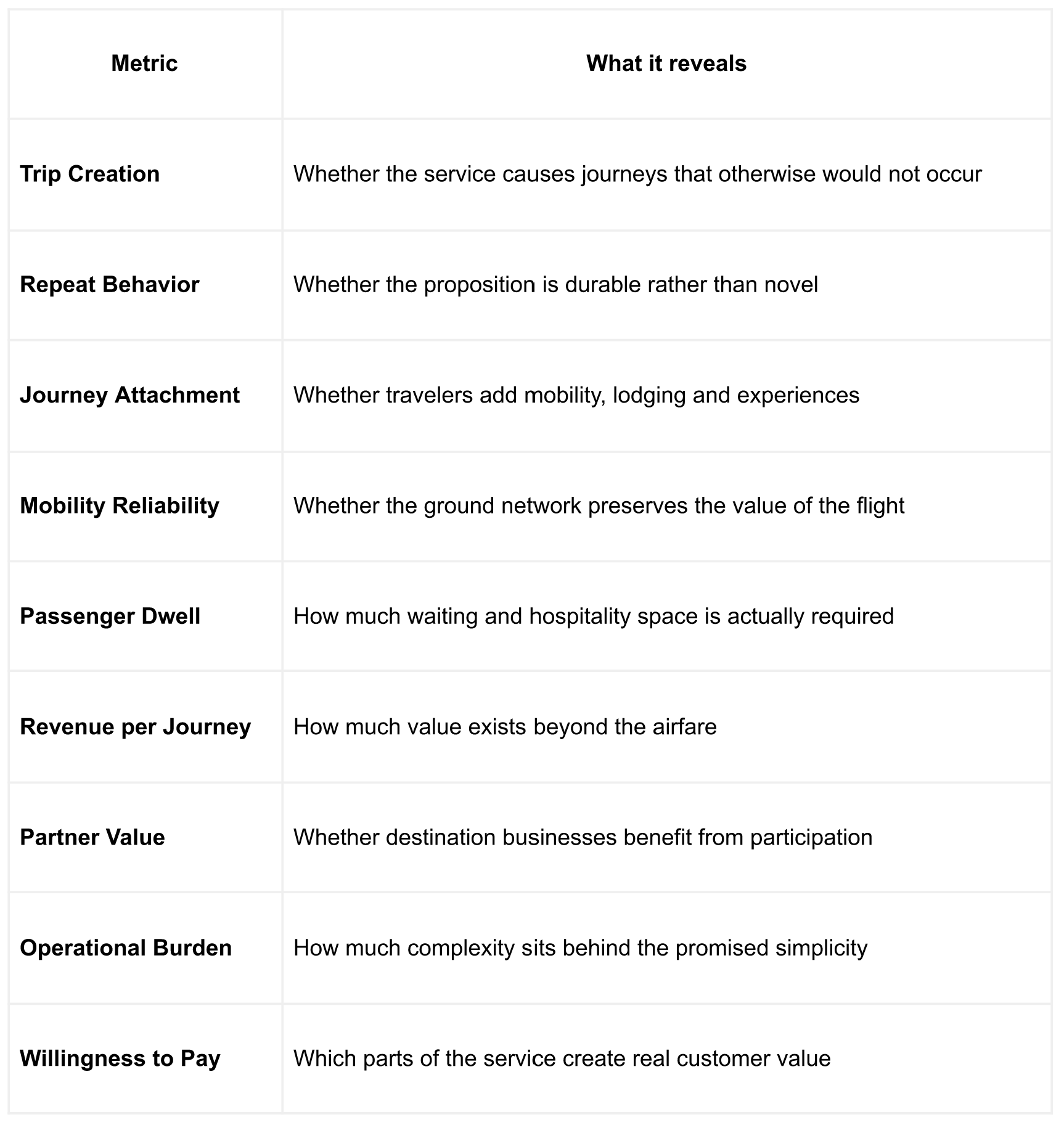
These are business metrics, but they are also architectural data. If passengers reliably arrive shortly before boarding, precautionary waiting space becomes harder to justify. If rental-car use falls, the transportation program changes. If luggage delivery proves valuable, baggage logistics deserve more attention.
The program begins emerging from observed behavior. That creates the central development discipline of the XBO:
Do not advance the building faster than the evidence.
XBO 1.0 — Protocol
Begin with the network: journey standards, mobility coordination, partner agreements, customer support, baggage procedures, payment and exception handling.
Advance only when recurring operations reveal problems that physical space or infrastructure can solve better than software, procedures or existing facilities.
XBO 2.0 — Interface
Invest at the handoffs proven to matter: mobility staging, energy, baggage transfer, passenger circulation, adaptable boundaries, local hospitality or other recurring physical requirements.
The node does not necessarily become larger. It becomes more specific.
XBO 3.0 — Place
A purpose-built facility becomes rational only where recurring demand, operating behavior, aircraft requirements and network economics justify it.
Some XBOs may never reach this stage, but that is not failure. A mature operating model that functions beautifully within existing real estate may be the better investment. The XBO does not reject architecture. It asks architecture to arrive with better information.
Back to TOC
09. When the Protocol Becomes Architecture
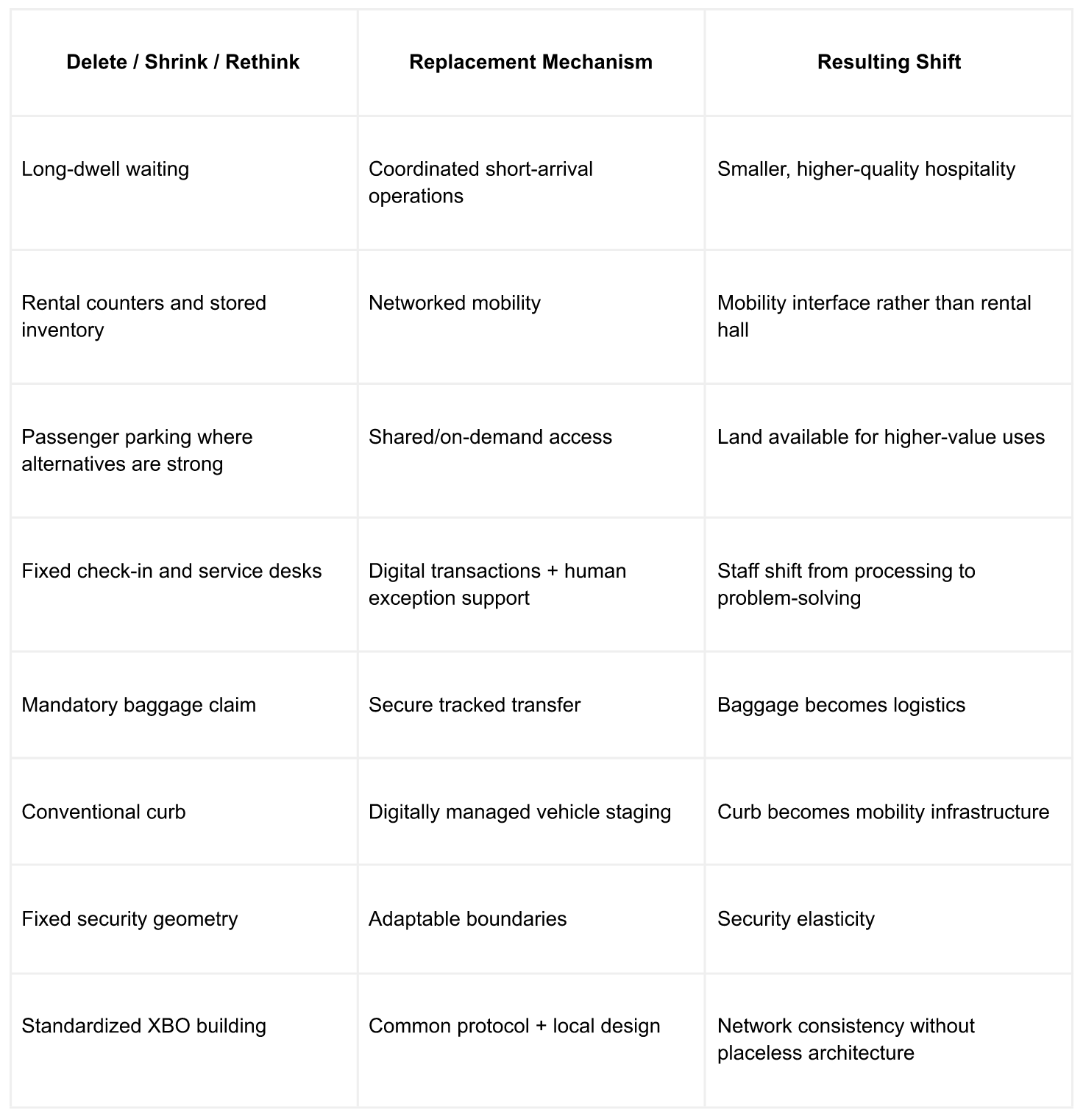
Eventually the operating model encounters the physical world often enough that permanent changes become valuable. That is when the XBO becomes a true architectural proposition. But the design question is not what a futuristic airport should look like. It is what the evidence allows us to shrink, rethink and add.
Shrink
Long-dwell waiting. If short-arrival operations prove reliable, waiting space can become smaller and better.
Rental-car space and stored vehicle inventory. If travelers increasingly buy mobility access, the airport can shift from vehicle possession toward vehicle handoff.
Passenger parking where alternatives are strong. Land used for storage may become available for more valuable uses.
Fixed transaction points. Digital identity, payment and itinerary management can reduce the need to turn every routine interaction into a permanent desk.
Rethink
The curb. It becomes a managed mobility interface for ride-hail, private vehicles, shuttles, rentals, bikes, luggage movement and potentially autonomous fleets.
Baggage. Where security and logistics permit, luggage can become an independent flow rather than a mandatory passenger ritual.
Security. Different aircraft and operating models may require different levels of control. The architecture should be capable of tightening or separating without losing its underlying simplicity.
Airside and landside. The XBO should preserve the directness of the small-airport experience while making the physical boundary clear, short and adaptable.
Add
Energy infrastructure. Aircraft, vehicles and facilities can turn airport power into a strategic operating system. It should be modular, expandable and resilient rather than permanently tied to one assumed future fleet.
Mobility staging. Networked transportation may require less vehicle storage but more precise choreography.
Digital operations. Redundant connectivity, cybersecurity, journey management, sensors, support and exception handling become critical infrastructure even when they occupy little passenger-facing space.
Experience. If less space is consumed by transactions and waiting, selected XBOs can spend more of the remaining architecture on the things buildings do well: food, landscape, social interaction, local identity, aircraft visibility and a sense of arrival.
A mature XBO could therefore be both smaller and richer than the conventional facility it replaces. Not a miniature terminal. Perhaps a mobility dock, an energy node, a baggage interface and a hospitality pavilion beside a runway. Different combinations would emerge at different airports.
The digital protocol provides consistency. Architecture provides place.
Back to TOC
10. Journey Margin
The XBO works only if the businesses required to produce the journey have a reason to participate. The aircraft operator needs viable flight economics. The airport needs revenue. The FBO needs operating value. The mobility provider needs utilization. Hotels and destination businesses want customers. Energy infrastructure needs a return. Customer convenience alone is not a business model.
One answer would be vertical integration: own the aircraft, vehicles, software, airport facility, hotel and destination services. That would create control. It would also create enormous capital and operational risk before the customer proposition had been proven.
The more interesting XBO model may be:
own less, coordinate more.
Let aircraft operators operate aircraft, hotels operate hotels and mobility providers provide transportation. The XBO makes their assets behave like one product. That changes the economic object.
Aviation naturally focuses on seat economics: fare, load factor, utilization and operating cost.
The XBO adds another question:
What is the total economic value of the journey that seat makes possible?
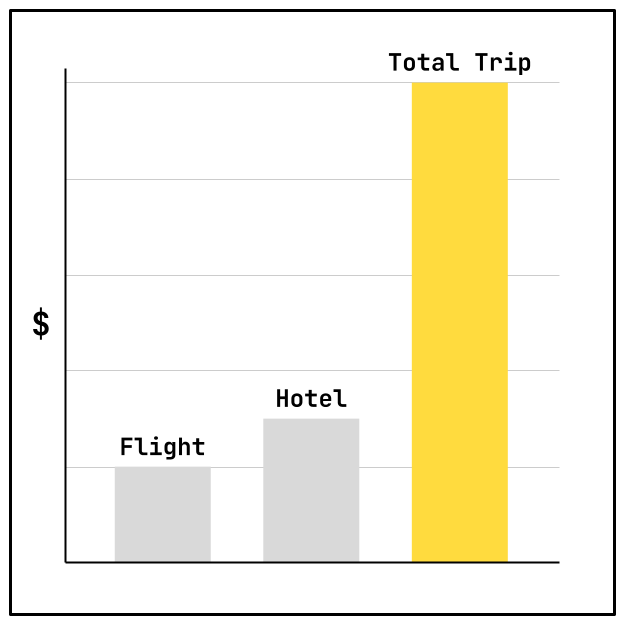
Imagine a $300 flight enabling a $2,000 weekend. The airfare is only one part of the activity created by the trip. Lodging, ground transportation, food, recreation, retail and events occur elsewhere in the destination economy.
The XBO does not need to capture all of that value. It needs a credible way to participate in some of the value it helped create. We can call that opportunity Journey Margin.
Journey Margin could come from commissions, bundled destination products, mobility, memberships, hospitality, events, energy, aviation services and eventually real estate.
The important shift is from asking only:
What did we earn from the passenger?
toward:
What value did this journey enable?
That matters to airports too.
Some XBO behaviors could weaken legacy revenue. Less private-car use can reduce parking. Less dependence on rental cars can affect concession economics. Short passenger dwell can reduce certain terminal purchases.
Integration only scales if those losses are replaced with new forms of value: mobility access, energy, leases, transactions, hospitality, aviation services or higher-value use of land previously dedicated to vehicle storage. The XBO is therefore a partnership model, not a technology product installed at an airport.
And the network itself can become a development advantage. A network-first operator can learn across multiple airports before deciding where physical capital matters most: which corridors create repeat travel, which destinations produce strong Journey Margin, which interfaces repeatedly fail and which existing facilities are already sufficient.
Operating intelligence becomes development intelligence.
The strategic asset is not necessarily the airplane or the building. It may be the ability to understand where a better journey creates enough value to justify both.
Back to TOC
11. Three Places, Three XBOs
The XBO becomes useful as a typology only if the same protocol produces different responses to different places. California offers three potential prototypes:
Napa asks whether the journey can be orchestrated.
Monterey asks whether a dispersed geography can be orchestrated.
Santa Ynez asks how little architecture a high-value destination might actually need.
Napa — Orchestrate the Journey
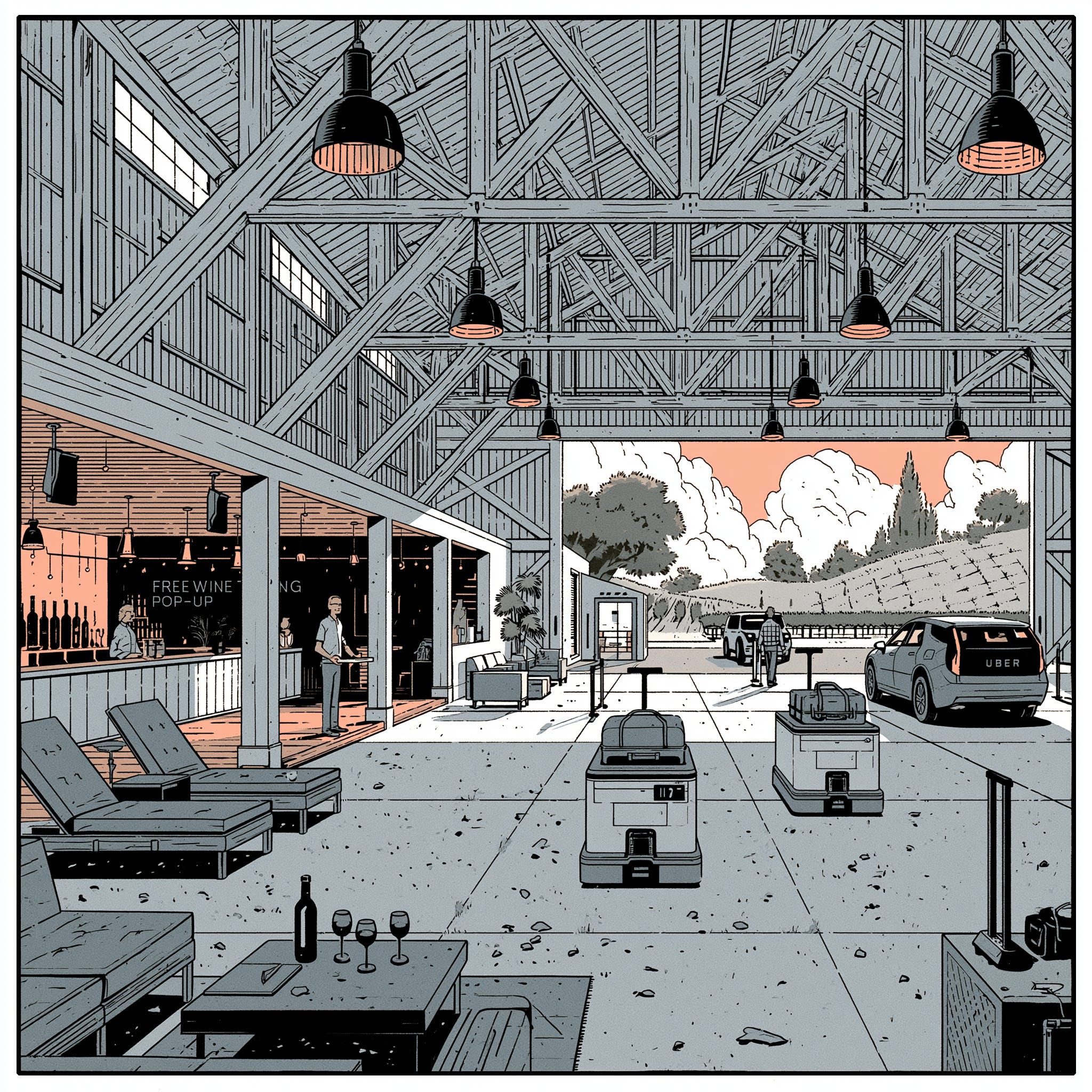
Napa may be the most practical place to test the XBO without waiting for future aircraft. The destination economy already exists. Transportation providers already move visitors among wineries, hotels and restaurants. Regional passenger activity and FBO infrastructure already exist at Napa County Airport.
The missing layer is continuity.
That makes Napa a test of the XBO’s most basic claim: can independently operated pieces of a weekend behave like one product?
The prototype should begin with as little architecture as possible.
What FFT would design:
a clear passenger path through existing FBO infrastructure;
a secure luggage handoff;
a precise ground-mobility interface;
compact, high-quality hospitality;
direct aircraft visibility;
and a digital journey connecting flight, mobility, lodging and destination reservations.
The important design work is not a new terminal. It is the operating relationship among the partners.
What Napa tests:
Can the XBO own the continuity of the journey without owning the assets that deliver it?
What could invalidate it:
If a destination as desirable and relatively orchestratable as Napa cannot generate meaningful repeat behavior, journey attachment or partner value, the broader XBO proposition should be treated skeptically.
Monterey, Carmel and Big Sur — Orchestrate the Geography
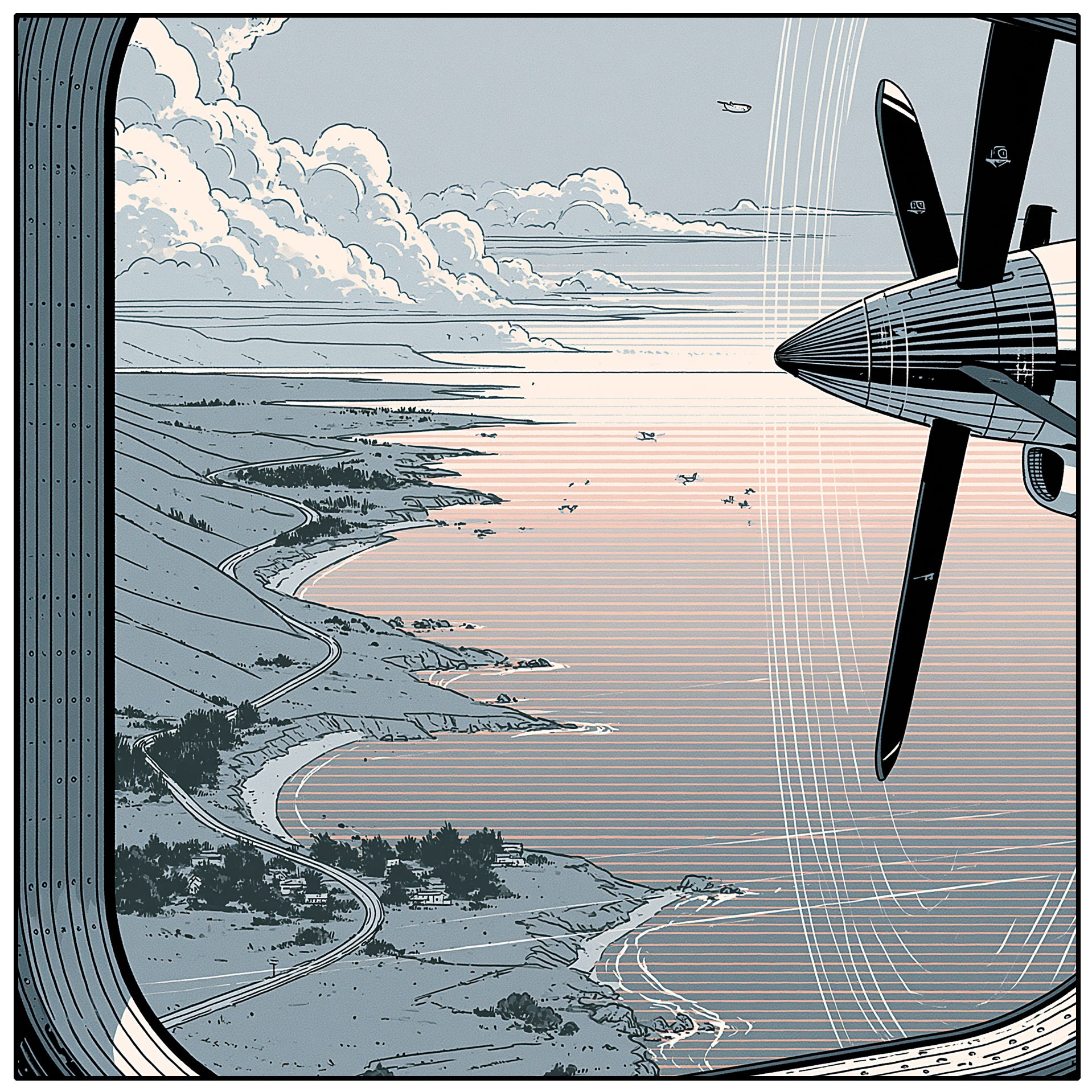
Monterey presents a different problem. The Experiential Catchment is unusually strong but dispersed. Monterey, Carmel and Big Sur form a linear destination in which the trip moves through geography.
Weather, traffic, road conditions, park access and seasonal demand can alter the journey after landing. The XBO therefore cannot solve Monterey simply by putting a vehicle at the airport. It has to make the geography usable.
That could mean a changing mix of private transport, hotel vehicles, bikes, guided excursions and eventually autonomous mobility. The protocol should be autonomy-ready, not autonomy-dependent.
What FFT would design:
an XBO layer that can coexist with the existing conventional terminal;
a destination mobility interface rather than a single rental solution;
a dynamic itinerary capable of responding to changing road or weather conditions;
and an Experiential Catchment map that treats Monterey, Carmel and Big Sur as connected journey nodes rather than isolated attractions.
What Monterey tests:
Can coordinated regional mobility make a dispersed landscape feel accessible enough for a short trip?
What could invalidate it:
A destination can remain desirable while being too geographically fragmented to orchestrate reliably. If the ground network cannot preserve the advantage created by regional flight, the corridor fails.
Santa Ynez — How Little Building?
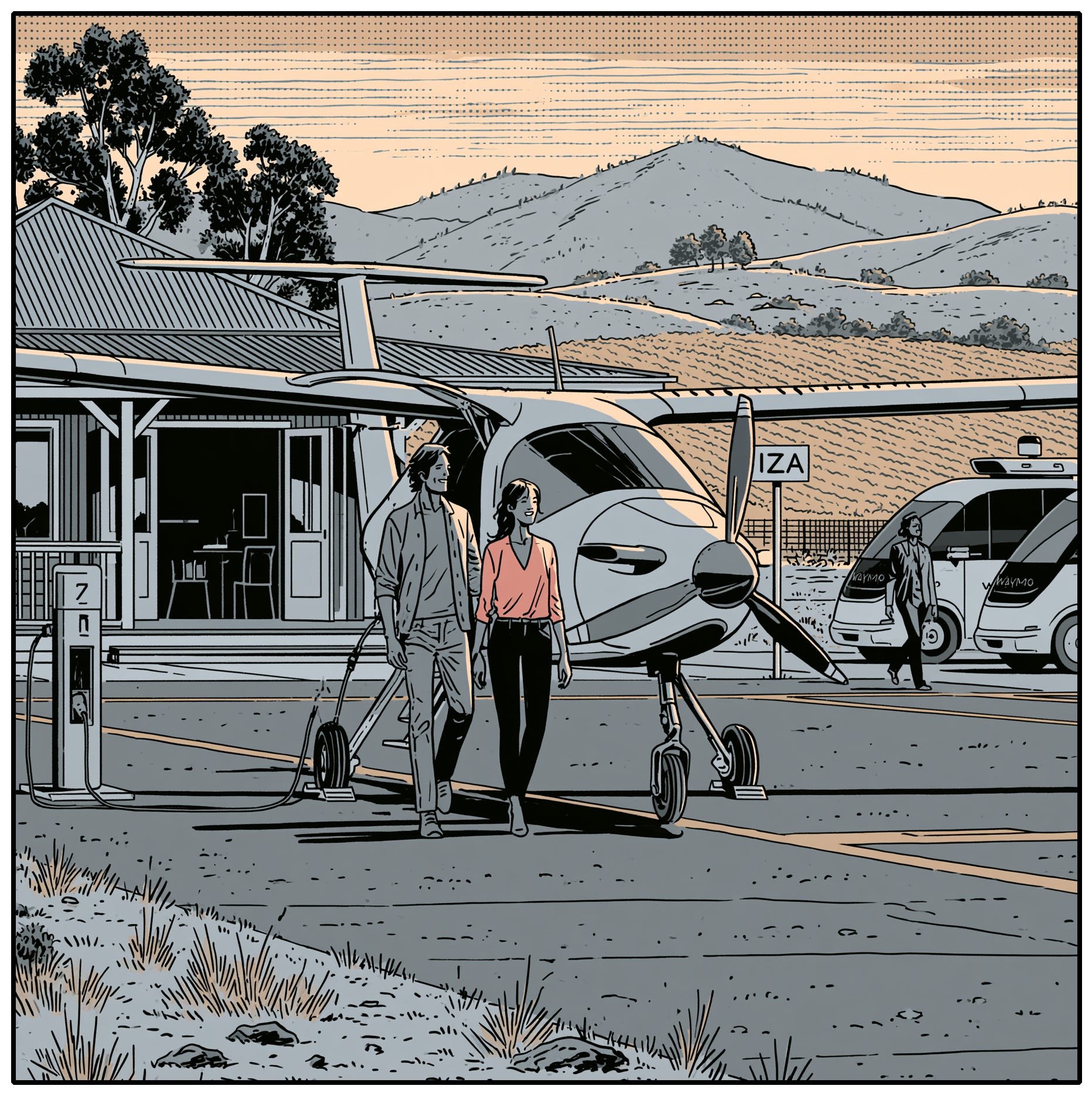
Santa Ynez is the most speculative of the three prototypes and the most revealing architecturally. The valley offers wine, food, boutique lodging, landscape, small towns and recreation close to a very small airport.
Its runway — approximately 2,800 feet long and 75 feet wide — also forces discipline. Not every future aircraft can serve every attractive destination, and Santa Ynez would be limited to smaller aircraft.
A five-seat aircraft and a thirty-seat aircraft create different requirements for runway, pavement, reserves, emergency response and energy. While the protocol can remain aircraft-agnostic, the physical node cannot.
If an appropriate commercial aircraft eventually fits the mission, Santa Ynez allows us to ask our most provocative architectural question:
How much building is actually necessary?
Perhaps very little.
A pavilion. A mobility court. Fast baggage transfer. Appropriate energy infrastructure. A good kitchen. Local wine. A terrace. Space for community or aviation events. A strong relationship to landscape and aircraft. The rest could remain digital.
The result might feel less like a terminal than a mobility lodge at the edge of a runway.
What FFT would design:
a small, hospitality-forward pavilion whose value comes partly from what it does not contain: no large rental hall, no acres of waiting space, no standardized concession corridor and no square footage justified by passenger behavior that has not yet occurred.
What Santa Ynez tests:
How little physical infrastructure does a high-value destination need?
What could invalidate it:
Aircraft fit. The destination can be perfect while the runway, fleet economics or operating requirements make viable service impossible.
Back to TOC
12. What Could Kill This Future?
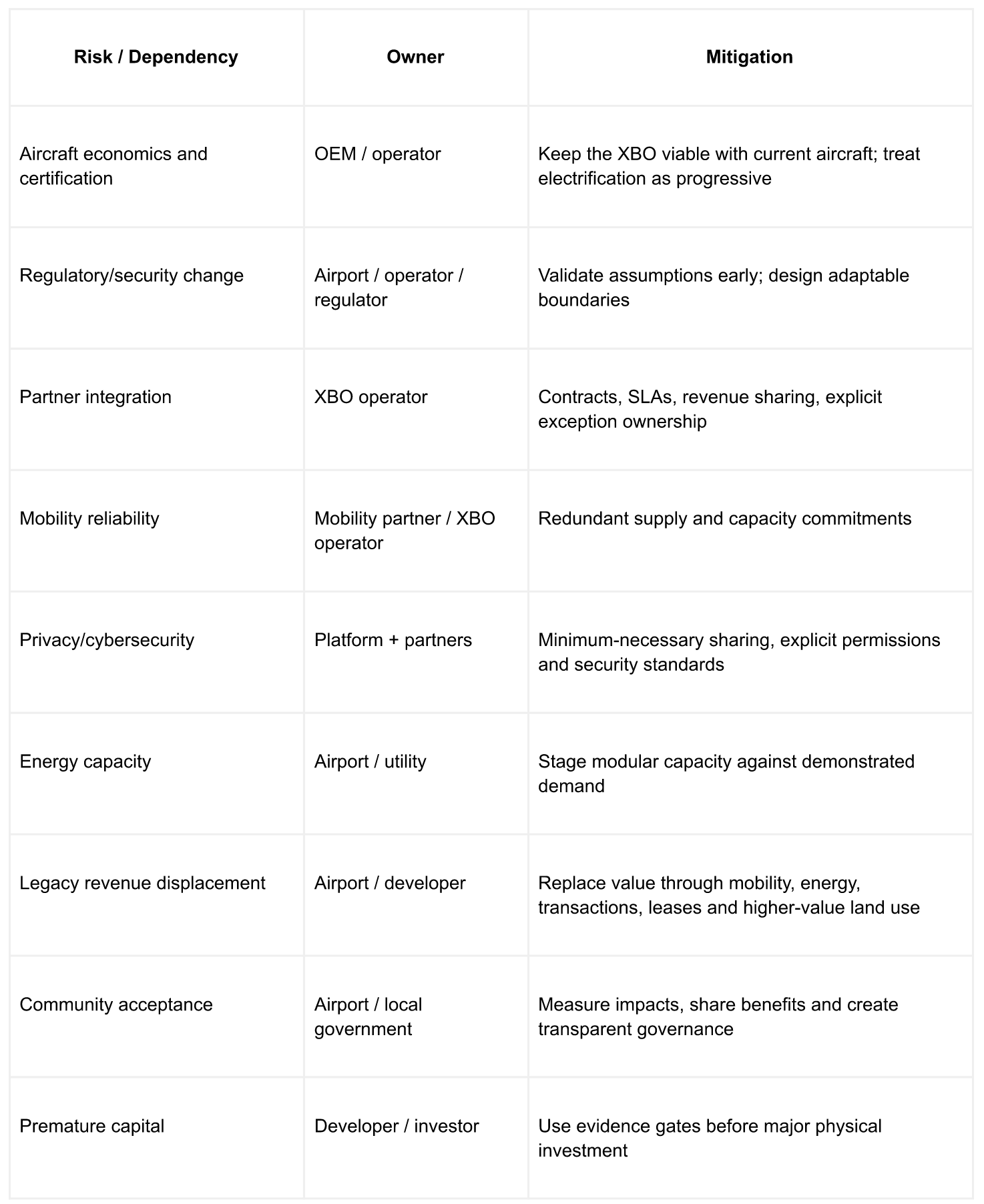
The XBO is compelling partly because several emerging systems could reinforce one another, but that also makes it fragile. It can fail even when individual technologies work.
The Aircraft Economics Never Arrive
Electric and hybrid-electric aircraft remain uncertain at mature commercial scale. Certification, capital cost, maintenance, battery replacement, payload, reserves, utilization, energy and financing all matter.
The XBO should therefore remain useful with existing aircraft. While electrification can strengthen the proposition, it should not be the only reason the proposition works.
The Product Is Too Expensive to Create New Demand
Electric Adventure makes a stronger claim than “some customers will pay for convenient regional aviation.” It proposes that lower-friction mobility can create incremental trips.
That has to be demonstrated in behavior. If travelers like the experience but do not travel more frequently, the XBO may still become a valuable premium service. The trip-creation thesis would simply be smaller.
Regulation Recreates the Terminal
Security and passenger-processing requirements vary by aircraft, operator and operating model. Today’s low-friction regional experience cannot be assumed to scale unchanged into every future service.
The XBO has to preserve simplicity through adaptable boundaries, digital processes where permitted and short passenger paths rather than by pretending regulatory requirements disappear.
Ground Mobility Breaks the Journey
A sixty-minute flight followed by forty minutes waiting for a vehicle destroys the proposition. The XBO therefore depends on transportation reliability, not on autonomous vehicles. The network should remain capable of using whatever modes actually work locally.
Integration Becomes Operationally Brittle
A delayed aircraft can affect transportation, lodging, reservations, baggage, energy and the return journey. Someone must own that cascade. The hardest XBO problem may be institutional rather than technical: service-level agreements, permissions, exception handling, customer support and explicit accountability across businesses that do not normally operate as one system.
Partner Incentives Do Not Align
The customer wants one journey, but the companies providing it may not. An airport can lose parking revenue. A hotel may prefer direct bookings. An operator may resist sharing data. A mobility company may not guarantee supply. The XBO only scales if customer value can be converted into participant value.
Energy Becomes the Bottleneck
Aircraft and vehicles can become large variable electrical loads. Grid upgrades can be slow and expensive, while future propulsion pathways remain uncertain. Energy infrastructure therefore has to be staged, modular and adaptable rather than designed around one supposedly inevitable technology.
Communities Reject Increased Activity
Quieter aircraft are not silent aircraft. A successful XBO can still increase flight activity, road traffic, development pressure or local controversy.
Cleaner technology does not provide automatic social license. Community benefit, measured impacts and transparent governance matter.
The XBO Works as Software but Never Becomes a Typology
This is the strongest challenge to the architectural thesis. A travel platform, airline, hotel company or AI agent could eventually coordinate many parts of the journey without producing a distinctive new building.
If orchestration creates no recurring physical consequences, we should not manufacture architecture to protect the idea. The XBO becomes a typology only where the operating model repeatedly changes mobility, baggage, energy, passenger circulation, parking, security, hospitality or other physical requirements.
The protocol has to earn the place.
The Developer Builds the Dream Too Early
This is the most avoidable failure.
The XBO is easy to render: aircraft, restaurant, mobility court, energy systems, landscape, event space. But building that image before observing the operation would destroy the concept’s most valuable strategic advantage.
Premature architecture is not only capital risk. It is typology risk: encoding an untested future into permanent real estate.
The XBO does not need every uncertainty resolved before anyone acts. It needs a way to learn without making irreversible bets too early.
Back to TOC
13. Innovation Architect Action Brief™
1. Strategic Action Thesis
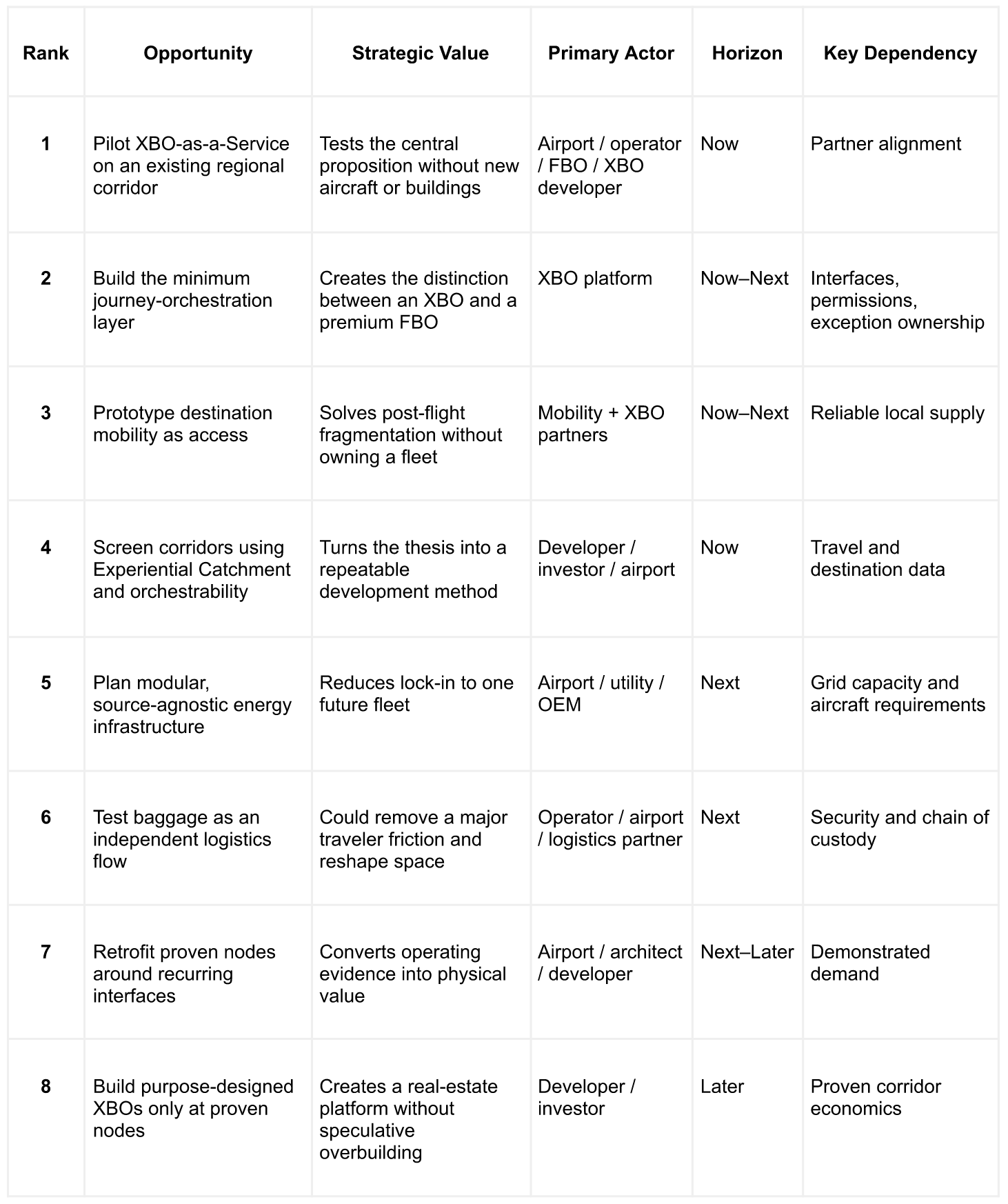
Do not commission an XBO building first. Commission an XBO corridor pilot using existing aircraft, existing airport or FBO infrastructure, existing transportation and existing destination businesses. Measure whether the journey creates demand, where coordination fails and which physical interfaces repeatedly matter. Capital should advance only when operating evidence reveals a problem that architecture or infrastructure can solve better than software, procedures or partnerships.
2. Legacy Assumptions to Break
Assumption 1: The airport ends at the property line
Old Logic: The airport handles aviation; what happens before arrival and after departure belongs to somebody else.
Why It Is Failing: The value of regional leisure travel depends on the complete destination journey.
Replacement Logic: Treat the airport as the physical interface to a wider journey network.
Assumption 2: A new aviation model requires a new facility
Old Logic: Forecast demand, write the program, build the terminal, then operate.
Why It Is Failing: Aircraft, security, mobility, energy and user behavior remain too fluid for premature spatial lock-in.
Replacement Logic: Prove the operating model first; let behavior generate the brief.
Assumption 3: Travelers need a vehicle after landing
Old Logic: Provide rental inventory and parking because visitors require a car for the duration of the trip.
Why It Is Failing: Transportation can increasingly be purchased as access.
Replacement Logic: Design for reliable mobility handoffs before designing for vehicle storage.
Assumption 4: Demand exists before the transportation service
Old Logic: Routes succeed by capturing enough existing travel.
Why It Is Failing: Lower-friction mobility may cause discretionary trips that otherwise would not occur.
Replacement Logic: Measure trip creation as well as captured demand.
Assumption 5: Airport space should optimize throughput first
Old Logic: The passenger enters, processes, waits and leaves.
Why It Is Failing: Digital systems can reduce some processing while selected nodes can create value through hospitality, mobility and destination exchange.
Replacement Logic: Design for efficient movement and, where evidence supports it, meaningful exchange.
3. Desired Outcomes
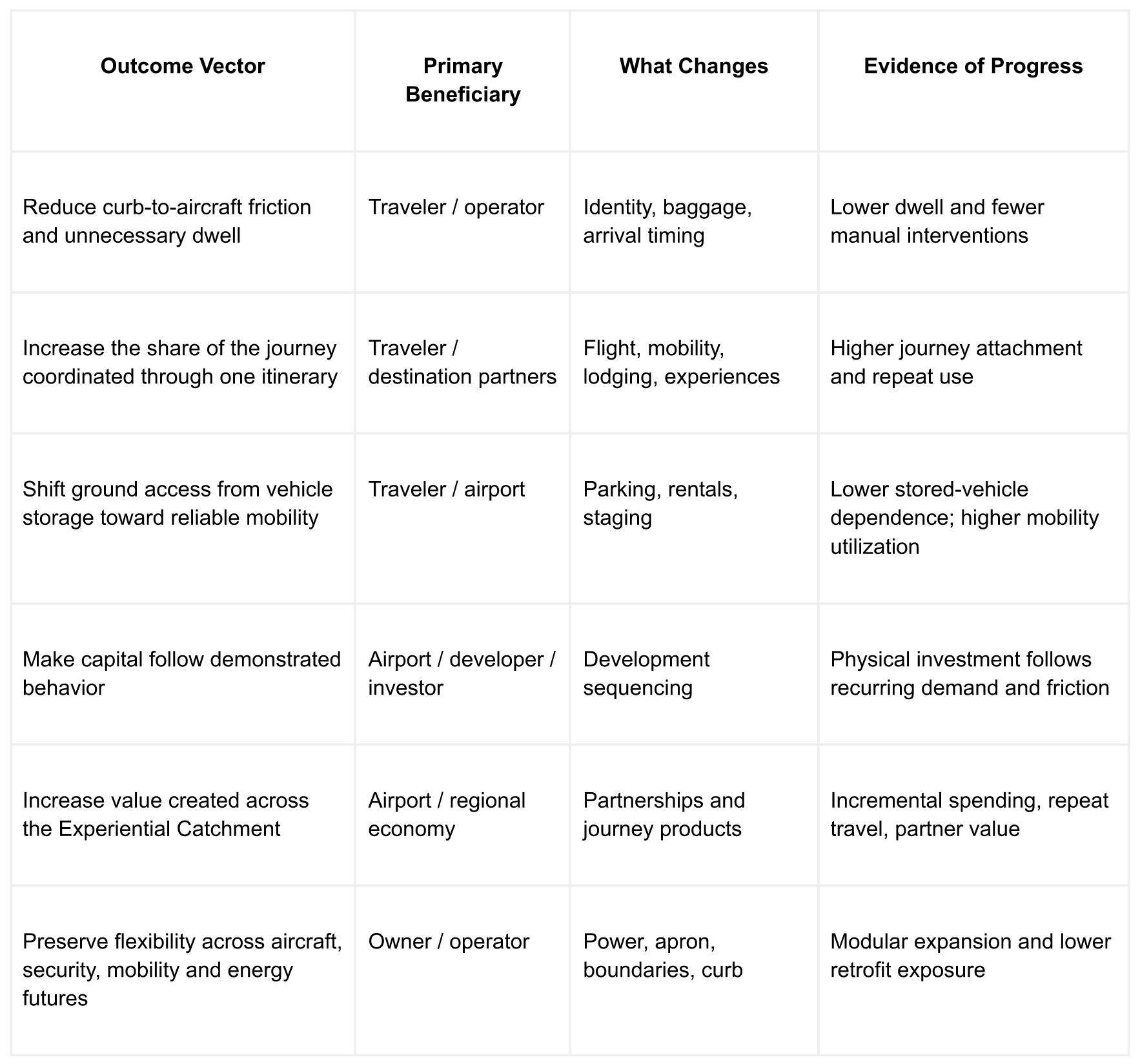
4. Strategic Opportunity Stack
5. Physical-Digital Integration Moves
6. Typology Deletions and Replacements
7. Adoption Roadmap
Now
Select one real corridor and map the journey from front door to destination experience.
Recruit a small aviation, mobility, lodging and destination partner group.
Prototype the coordinated itinerary manually before building full software.
Establish baseline measures for dwell, trip creation, journey attachment, mobility reliability, partner value and operating burden.
Audit the participating airport’s electrical, baggage, curb, passenger, regulatory and data conditions.
Next
Operate a limited pilot with real customers.
Automate only the integrations the pilot proves necessary.
Test mobility access using existing transport before autonomous vehicles are required.
Prototype small physical interventions at proven handoffs.
Produce the first evidence-based XBO building brief.
Later
Retrofit high-performing nodes around recurring physical-digital interfaces.
Expand energy capacity as fleet requirements become clearer.
Add corridors using the same screening method.
Integrate autonomous mobility where it genuinely improves reliability or economics.
Develop purpose-built XBOs only where retrofit no longer captures the opportunity.
8. Risk, Dependency, and Governance Map
9. Monday-Morning Moves
For Airports and FBOs
Map one passenger journey beyond the property line and identify one handoff the airport could coordinate instead of simply passing along.
For Developers and Investors
Screen three candidate corridors before acquiring land or drawing a building. Start with origin access, Experiential Catchment, orchestrability, aircraft fit and partner readiness.
For Aircraft Operators and OEMs
Treat the ground journey as part of aircraft adoption. Identify which airport and destination interfaces could materially improve route preference or economics.
For Architects
Draw the XBO twice: first as an operating diagram containing no rooms, then as a physical plan. Challenge every space that cannot be traced to a proven function, regulatory requirement, interface or valuable human experience.
For Mobility, Technology and Destination Partners
Build one bundled journey with today’s systems. Test whether coordination changes what customers book, how much they spend and how often they travel.
10. The Non-Obvious Opportunity
The XBO’s most defensible long-term advantage may not be owning the airport experience. It may be learning where physical capital should go before anyone else knows.
A network operating across multiple corridors can observe which destinations create trips, which services produce Journey Margin, which handoffs repeatedly fail and which existing facilities are already sufficient. That information turns operating behavior into a site-selection and capital-allocation advantage.
The building is no longer the experiment. It becomes the investment made after the experiment has already taught you where architecture creates value.
Back to TOC
14. Form Follows the Journey
This Edition began with a weekend, and that matters.
The most useful way to think about technological change in the built environment is not to begin with the technology — or even with the building. Begin with what becomes newly possible for people.
If regional mobility becomes easier, some trips may become spontaneous. If those trips become more connected, the airport’s functional boundary can expand into a destination. If coordination moves into software, some inherited rooms can shrink while new physical interfaces become critical. If those changes alter economics, the business model can move beyond the seat toward the value created by the journey. Only then does a new building type begin to appear.
That sequence is the larger lesson of the XBO. A conventional design brief often presents today’s functions as facts: people wait, therefore provide waiting space; people rent cars, therefore provide rental infrastructure; people process at desks, therefore provide desks. But every one of those functions contains an assumption about the future.
Typology Strategy begins earlier. It asks which capabilities technology is changing, which behaviors may follow, what economics and operating models those behaviors alter, and which physical requirements remain once those changes are understood.
The objective is not to remove architecture from the process. It is to improve the assumptions architecture receives.
Some functions will disappear into networks. Some will remain but require less space. Others — energy, mobility handoffs, baggage logistics, connectivity, adaptable boundaries — may become more important precisely because the customer experience becomes more digital.
And some locations may never justify a new building at all. That is why the XBO’s most important architectural principle is also its most disciplined one:
Earn the building.
Design the journey.
Connect the systems.
Observe the behavior.
Identify the interfaces.
Then decide what deserves to become architecture.
The future regional airport does not begin when someone draws a new terminal. It begins when the journey changes enough that the old assumptions no longer make sense.
